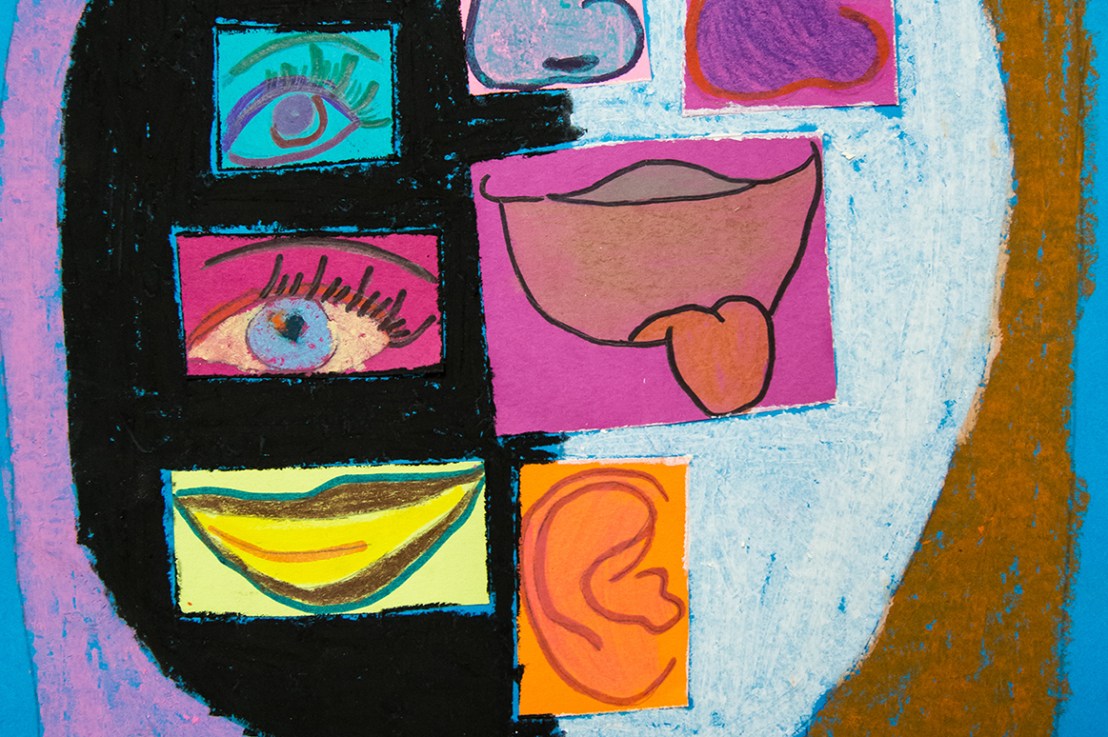
Students practiced aspects of traditional figure study, learning to draw facial features, hands and feet. Students then built on their experience to explore the Cubist approach to the figure, and used what they learned about Cubism to create a cubist-inspired portrait or figure collage their earlier drawings.
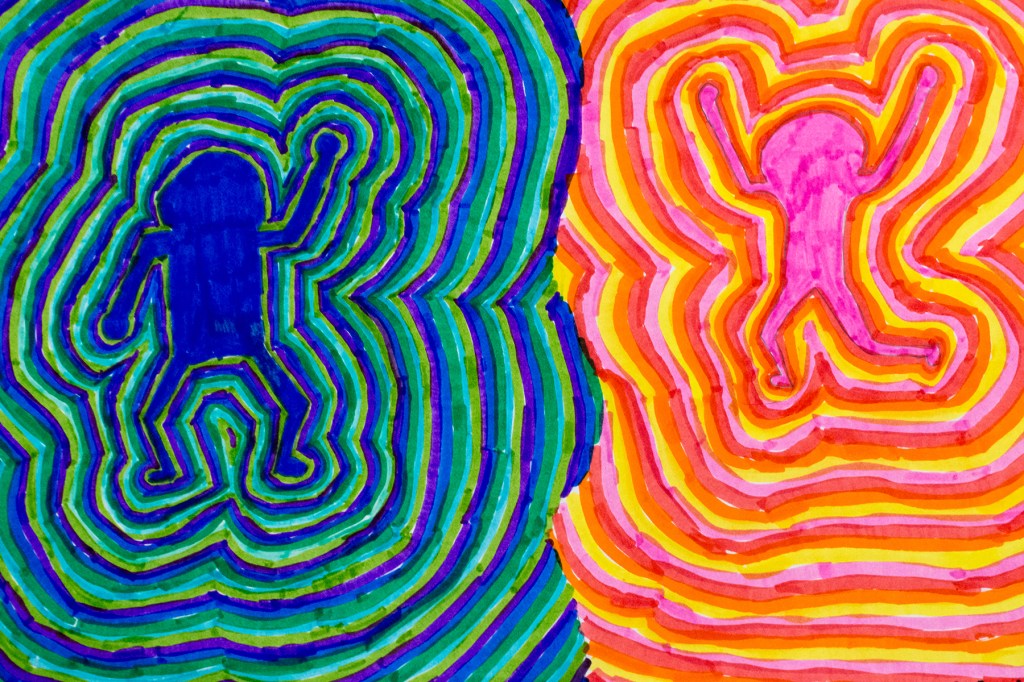
Students explored the work of contemporary New York artist Keith Haring. A crafty, resourceful and thoughtful artist, Haring created artwork with powerful messages using deceptively simple, cartoon-like designs in a variety of spaces, both private and public. His work was accessible to a diverse public in ways few artists had achieved.
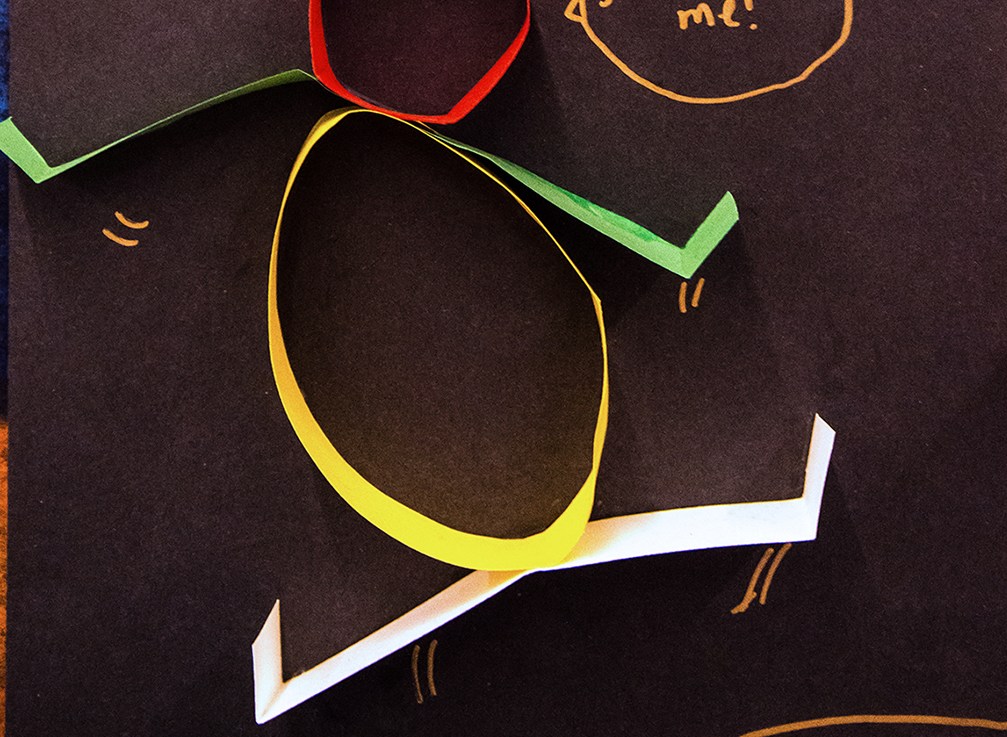
Students observed and discussed his use of bold, primary and secondary colors, but more importantly they focused on Haring’s use of straightforward line to suggest movement, gesture and feeling. Students attempted their own designs inspired by the characteristics of Haring’s work. The first lesson had students create designs in 2-D, the second in 3-D.
Description of the Unit – Students will create yarn paintings in the style of the Huichol of México.
Activity statement – The Huichol are a culture native to western México (mostly in Jalisco and Nayarit) who have preserved many of their ancient arts and crafts practices. So esteemed are they to Mexico’s heritage that the Mexican government and UNESCO have made great effort to preserve the culture and its environment. While the Huichol first used materials found in nature to produce their art, they now Huichol use modern materials and dyes in their crafts. Among the many incredible crafts the Huichol produce is the yarn painting, an intricate, highly colorful tableau of symbols and images “painted” with bright yarn arranged in bold patterns.
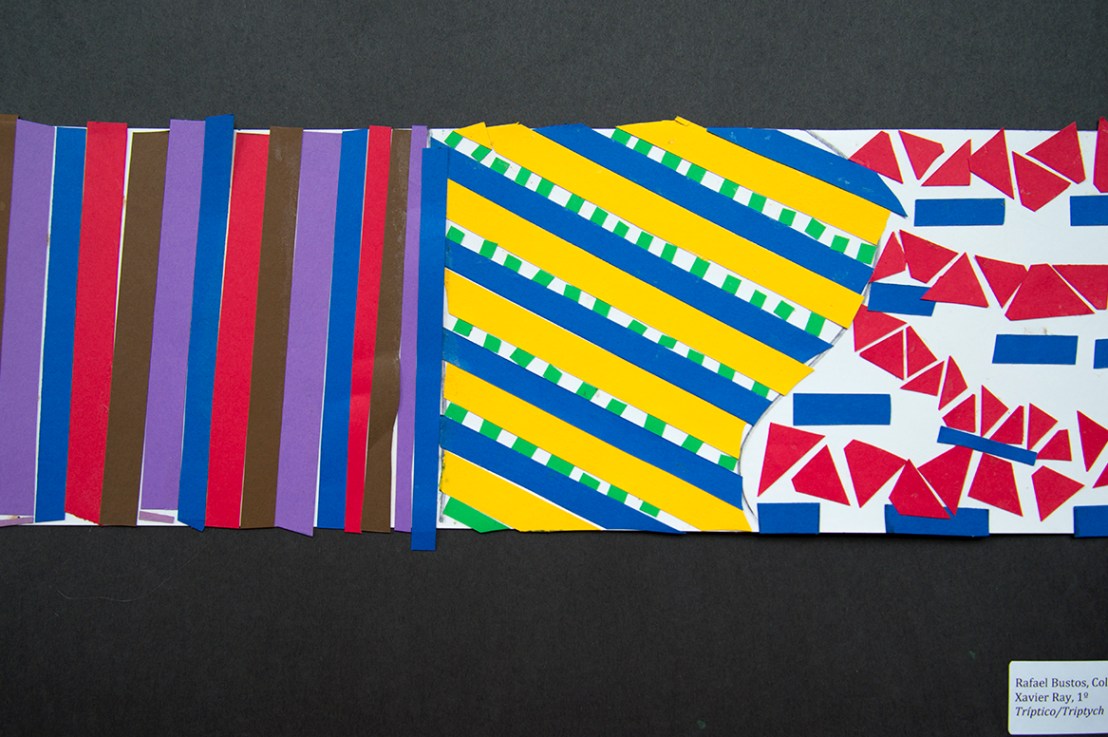
Students will reinforce their understanding of patterns in art by creating collage patterns both individually and then in trios for a triptych of patterns.
Activity statement –
Pattern is one of the elements of the visual arts. It is represented as repetition, be it of a color, line, shape, symbol or combination of some or all of these. The repetition can serve to communicate a sense of balance, rhythm, harmony, movement and contrast in the artwork.
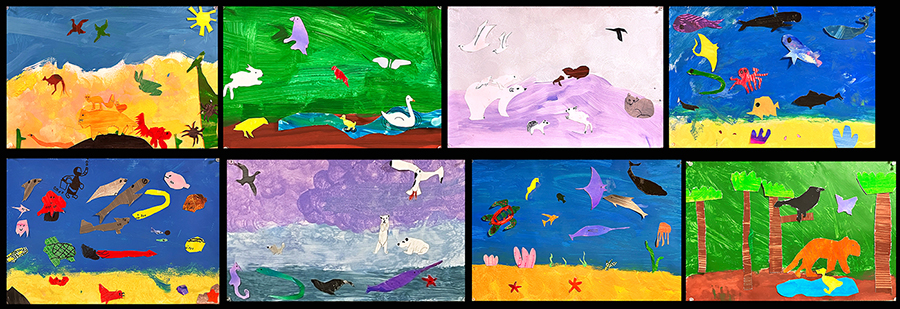
Integrated with a science unit on ecosystems, students will create an Eric Carle-inspired collage of an ecosystem.
Ocean ecosystem by kindergarten student: for this she used a dolphin stencil to help her
Activity statement –
In kindergarten science students explore an entire unit devoted to ecosystems. They learn about earth’s many ecosystems: climate, flora, fauna and so forth. Each student is assigned a specific ecosystem to research and present to the class. This collage will be one of the visual elements used in their reports.
To inspire the collage-making process, we will look at different Eric Carle books and notice his painted paper collages. Using his techniques as a guide, we will focus on color and texture as students first paint large pieces of paper in single colors and then add texture with the brushes, combs, forks, rollers and other tools provided. These pieces of paper will be used communally among the students for their collages, therefore no one piece belongs to one student.
Students create a basic nighttime one-point perspective drawing that includes a vanishing point and a horizon line.
5th grade 1-point perspective drawing
Problem/Activity statement –
As objects recede in space, they become smaller to our eye, and eventually meet at a point. A horizon line meets at a vanishing point to separate sky and ground. Students will observe different examples of cities one-point perspective to begin to get a sense for how we perceive things up close and at a distance, as well as to learn to identify whether the perspective is high (“bird’s eye view”) at eye-level, or low (Cat’s eye view”). Additionally, students are challenged with expressing the qualities of color and light at night.
In this unit students will explore the relationship between positive and negative space via the elaboration of a Notan design using both geometric and organic shapes.
4th grade Japanese Notan Designs
Activity statement –
Notan is a design concept of Japanese origin that plays with the relationship (what I like to call “the dance”*) between dark and light, or rather positive and negative space, and how the existence of one naturally engenders the other. Using both organic and geometric shapes cut out of a rectangle and then flipped over, students will experiment with the way shapes contribute to a dynamic relationship between positive and negative space. This unit also satisfies requirements within the California Visual Arts Standards for fourth grade, including 1.2 under Artistic Perception, “describe how negative shapes/forms and positive shapes/forms are used in a chosen work of art”; and 2.6 under Creative Expression “use the interaction between positive and negative space expressively in a work of art.”
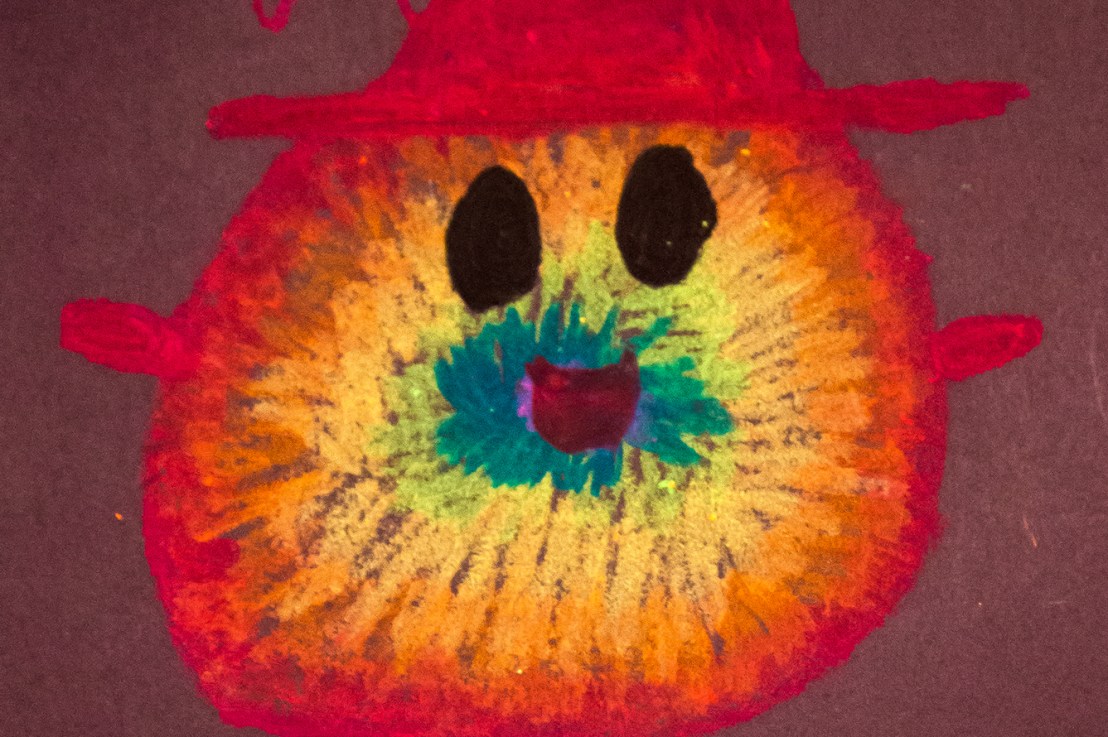
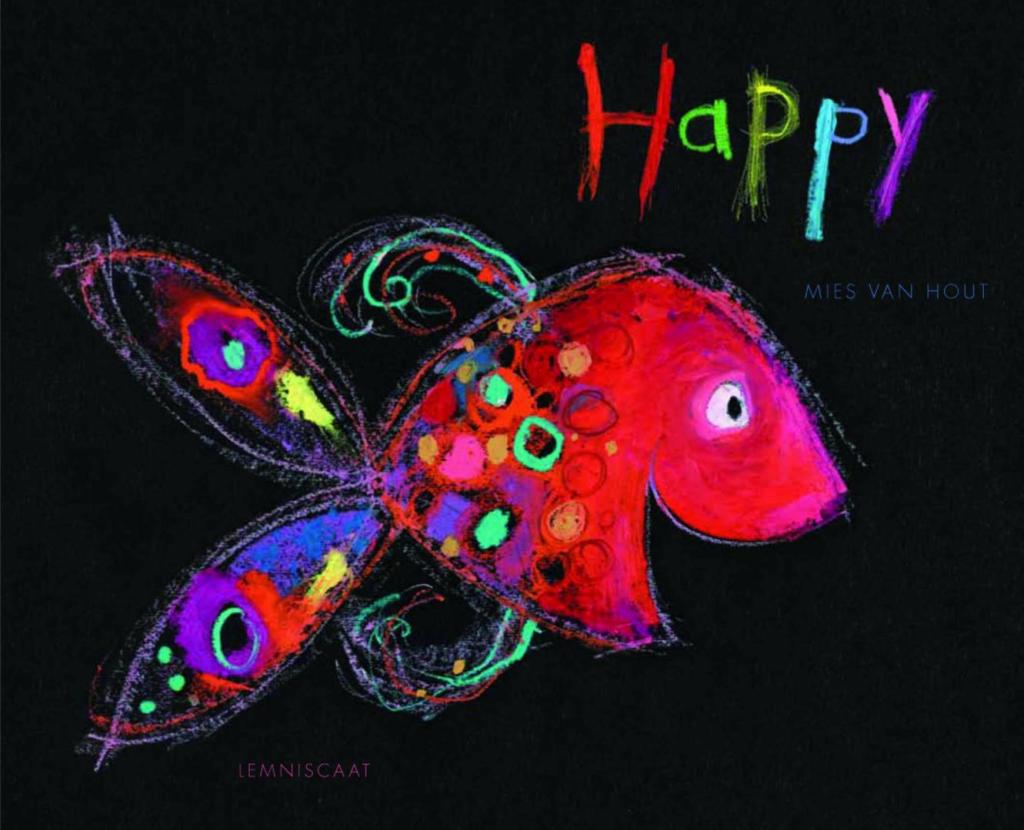
Activity statement – If “sad” had a color, what color would that be? If “confused” were expressed in lines, what kind of lines would those be? By exploring the associations of color and lines to certain feelings, students will imagine little creatures that personify those feelings, much in the style of Mies Van Hout’s book “Happy”.
Description of the Unit – Together in class we explored and discussed Mies Van Hout’s picture book “Happy”. In this book Van Hout has colorfully illustrated a number of different fish, each with clearly gestural lines personifying a different emotion (also helped by the expression on each fish’s face). In this book, each emotion is represented in the fish through use of color and line. The students discussed why they thought a particular fish was represented by certain colors or lines to describe a particular feeling. Students shared their own synesthesia around feelings, conveying what colors and types of lines they associate with a certain feeling.
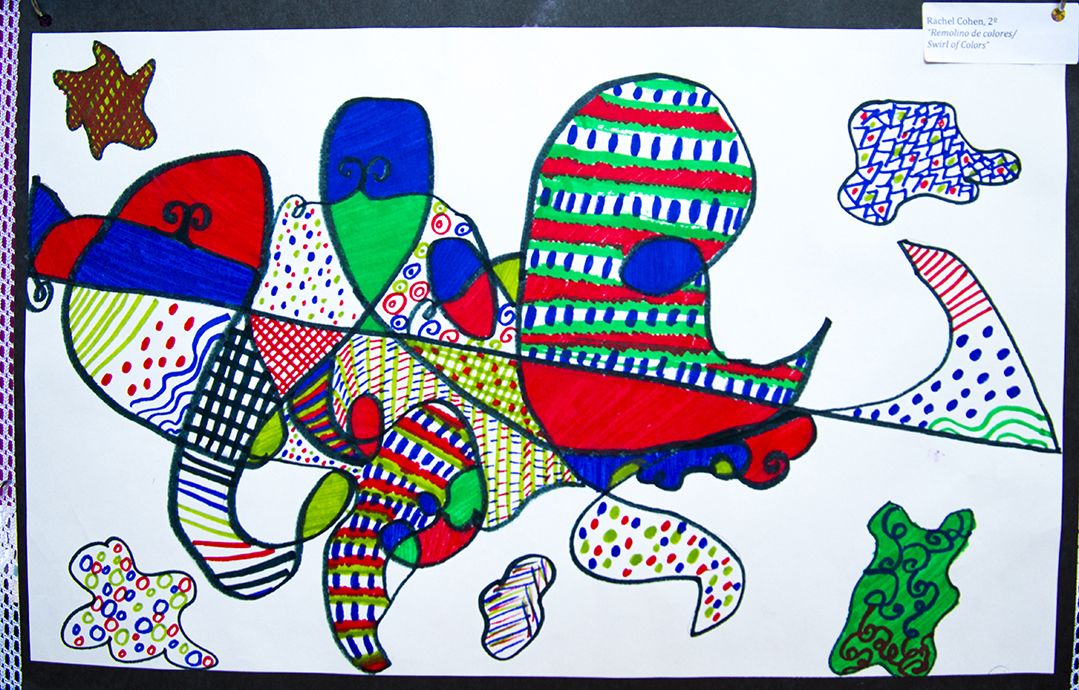
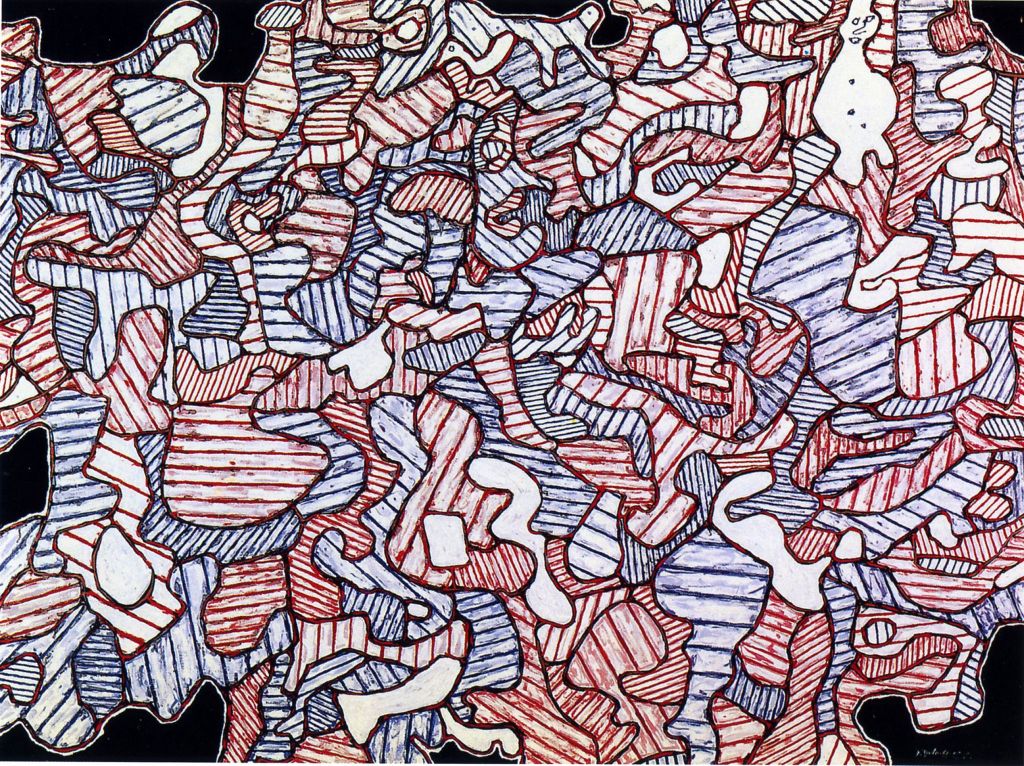
Description of the Unit – Emphasizing line and pattern with Jean Dubuffet’s Hourloupe style
According to one of my favorite modern art history sites, the Art Story, “Dubuffet’s L’Hourloupe series began in 1962 and would preoccupy the artist for many decades. The inspiration came from a doodle he created while on the telephone, in which the fluid movement of line combines with limited fields of color to create movement. He believed the style evoked the manner in which objects appear in the mind,” (https://www.theartstory.org/artist/dubuffet-jean/artworks/#pnt_5).
Jean Dubuffet, Banque des équivoques, 1964
Students love to learn about the origin of the Hourloupe series, being surprised at how much can be done with a seemingly simple doodle. They like the notion of trying to find hidden images within the doodle as well.
As students are shown ways to embellish a doodle with a variety of lines and patterns, we are given the opportunity to reinforce their understanding of repetition and pattern (having been introduced in kindergarten and practiced in 1st grade). To be able to identify and practice repetition and pattern is prescribed in most states’ standards for second grade visual arts.
2nd grade Jean Dubuffet-inspired design
As we observe Dubuffet’s Hourloupes, I call students’ attention to his minimal use of color, and have them comment on whether the colors are primary or secondary, and whether they are complementary. Later when making their own designs I have them also choose only a few colors, and have them think about whether they want the colors to be mostly warm or cool.
Description of the Unit – Frida Kahlo-inspired self-portraits
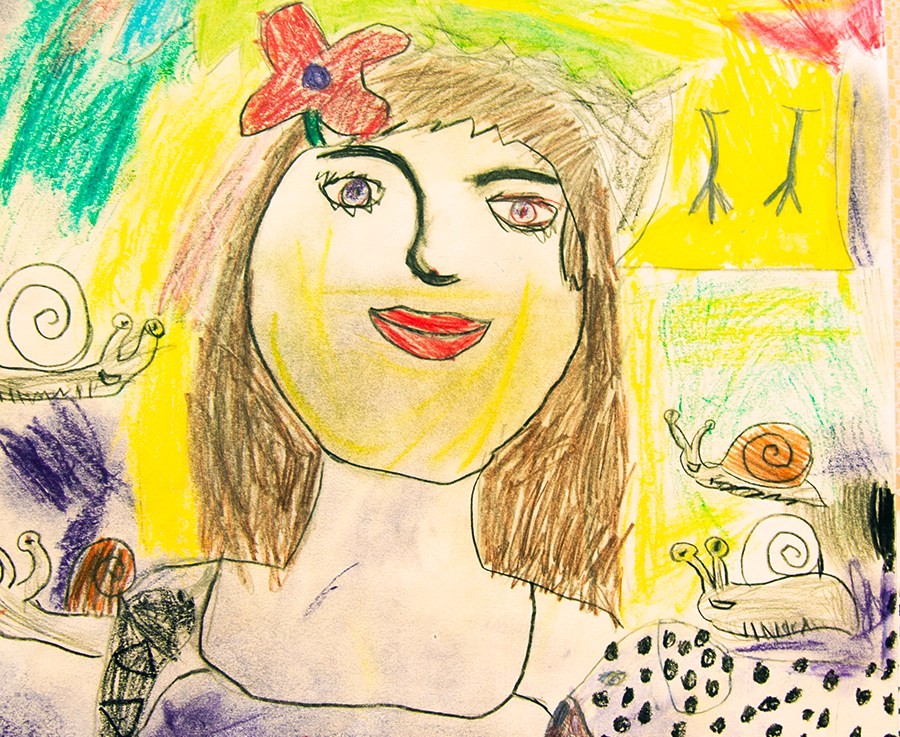
Students will explore Frida Kahlo’s iconic self-portraits and, using their observations of her work, create their own, including at least one “spirit” animal in the portrait with them.
Self portrait with Bonito, 1941
Relationship to life –
Frida Kahlo was a prolific painter whose most painted subject was herself. She often painted herself with various animals by her side, such as monkeys, parrots, hummingbirds and deer. Some of these were her real life pets, others were animals she identified with. If students had to choose animals that they personally identify with, what animals would they be, and why?










 In the K-8 Art Studio with Anita Sagastegui