8th Grade – Chiaroscuro Drawing with CJ Hendry

8th Grade – Chiaroscuro Drawing with CJ Hendry

Description of the Unit –

We begin by diving into the fascinating art of CJ Hendry. Hendry expresses having no formal art training and considers herself “not very creative.” Yet she’s a dedicated, innovative artist whose works are primarily hyper-realistic, large scale pencil drawings of (mostly) luxury objects that sometimes take 200 hours to complete. Working with pencil on paper her pieces are achieved through layers of what she refers to as scribbles. Watching her work (you can see some fun videos of her at work here: https://youtu.be/KB8vc9M4QWs and https://youtu.be/KixMpzhMS-o) students become awe-struck by the way her tireless pencil strokes beget such lifelike representations of real-life objects.

two images of artist CJ Hendryy working on her drawings, one of a pair of men's Gucci shoes, another of a boxing glove
Artist CJ Hendry at work

Students learn to recognize how light and shadow in a realistic drawing can be expressed through a value scale. I give students a value scale and have them look at different black and white photographs while identifying which tones from the value scale are present in each photo.

Value scale
Value scale

To help deepen their understanding of value students practice filling in their own scale in pencil, then use that scale to draw a simple egg from a photo reference.

They students choose from among several different black and white still life and portrait photographs to use as a reference for their own chiaroscuro still life. A chiaroscuro drawing is made on medium-toned paper using both dark and light (usually white) lines to create the illusion of three dimensions.

Activity statement –

Learning to draw three-dimensional objects, paying attention to light, shadow, value, tone and perspective, are fundamental lessons of art. In this unit students will learn what a value scale is and how that is used to express the three-dimensional qualities of light and shadow in a chiaroscuro drawing. They will fill in their own value scale before beginning a chiaroscuro still life (from a photo reference) to fully understand the subtle shift in tones from light to dark.

Goals – Students should…

Understand:

  • The element of value in art
  • The term chiaroscuro
  • How a value scale works

Know:

  • What a value scale is
  • What each of the following types of shadows mean: form, core, occlusion and cast shadow

Be able to:

  • Create a value scale
  • Be able to express light, shadow and value in a monochrome drawing

Objectives – Students will:

  • Observe value as expressed in drawing
  • Create a value scale
  • Render one monochrome still life in graphite and charcoal via a photographic reference

Resources and materials –

  • (If you want to include CJ Hendry’s work) Examples and videos of CJ Hendry’s work
  • Exemplars of still life in charcoal and graphite that students can observe
  • Value scale worksheet
  • Grayscale ruler
  • Black and white still life photo references
  • White Bristol paper (9 x 11)
  • Black Bristol paper (9 x 11)
  • Graphite drawing pencils in diverse tones (HB, 3B, 5B, 6B, 9B)
  • White drawing pencils
  • Charcoal
  • Blending stomps
  • Paper towels
  • Rulers

Questions –

  • Can you count the number of different grays in (given) image? Why are there so many?
  • Point to the form shadows in the image.
  • Point to the cast shadows.
  • Where do you see the brightest white? Why is it there?
  • Where do you see the blackest black? Why is it there?
  • How can you convey the appearance of light and shadow in drawing?
  • How can you convey perspective in drawing?

Evaluation – Did students:

  • Understand the difference between form and cast shadow?
  • Notice the variety of grays one can use in chiaroscuro drawing?
  • Attempt to render value and perspective in their drawings?

Informal:

  • Student questions
  • Group discussions
  • Oral responses to essential questions
  • One finished value scale
  • One finished drawing
An 8th grade student's chiaroscuro drawing of a white pitcher with grapes, a pear and several more grapes resting beside it on a table, on gray toned paper
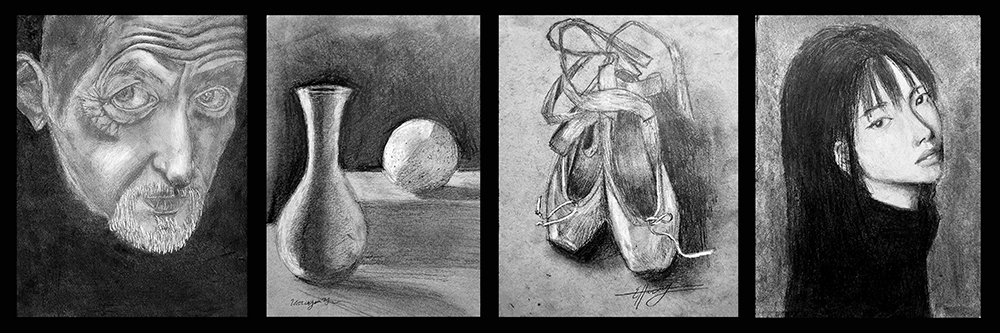
This, as well as the following images, are all chiaroscuro drawings done by my 8th grade students
An 8th grade student's chiaroscuro drawing of a Converse high-top sneaker on gray toned paper

An 8th grade student's chiaroscuro drawing of a a pipe, two books, and a white cup of black coffee all resting on a table on gray toned paper

An 8th grade student's chiaroscuro drawing of a young Asian woman with sleek black hair and a black turtleneck on gray toned paper

An 8th grade student's chiaroscuro drawing of a pair of ballet pointe shoes on gray toned paper

An 8th grade student's chiaroscuro drawing of a vase and an orange on gray toned paper

An 8th grade student's chiaroscuro drawing of an older man with a white beard on gray toned paper

An 8th grade student's chiaroscuro drawing of a skull on gray toned paper
8th grade – watercolor & mixed media

8th grade – watercolor & mixed media

Description of the Unit – This is a purely technical unit that allows students to explore combining watercolor painting techniques with other media.
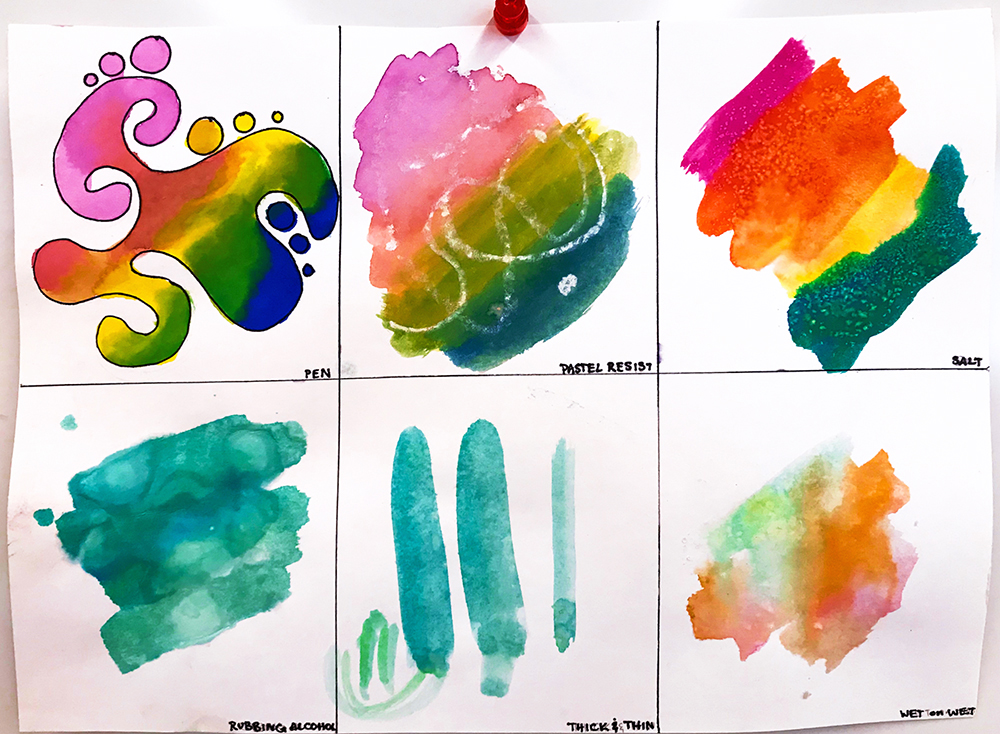
An 8th grade student's technique sheet representing watercolor mixed with various media
An 8th grade student’s technique sheet. These are experiments that add a variety of media to watercolor to test the effects
Continue reading “8th grade – watercolor & mixed media”
7th Grade – Japanese Notan Designs

7th Grade – Japanese Notan Designs

Description of the Unit –

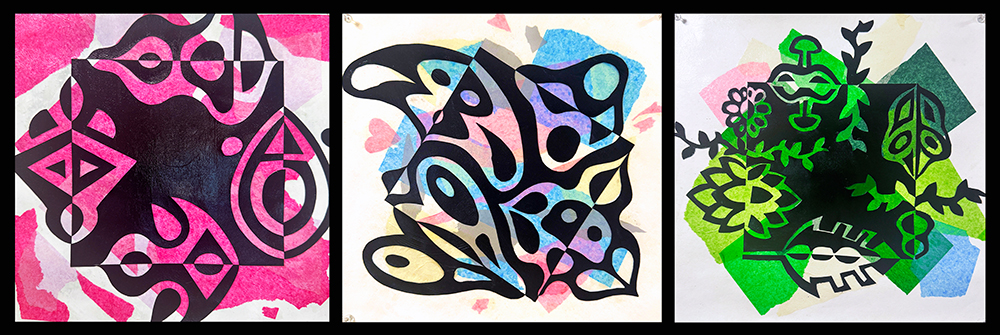
In this unit, students observed the traditional Japanese art of Notan designs, exploring the relationship between positive and negative space between elaborately cut designs, and how this relationship affects composition, balance and symmetry. Students created their own Notan designs.

Continue reading “7th Grade – Japanese Notan Designs”
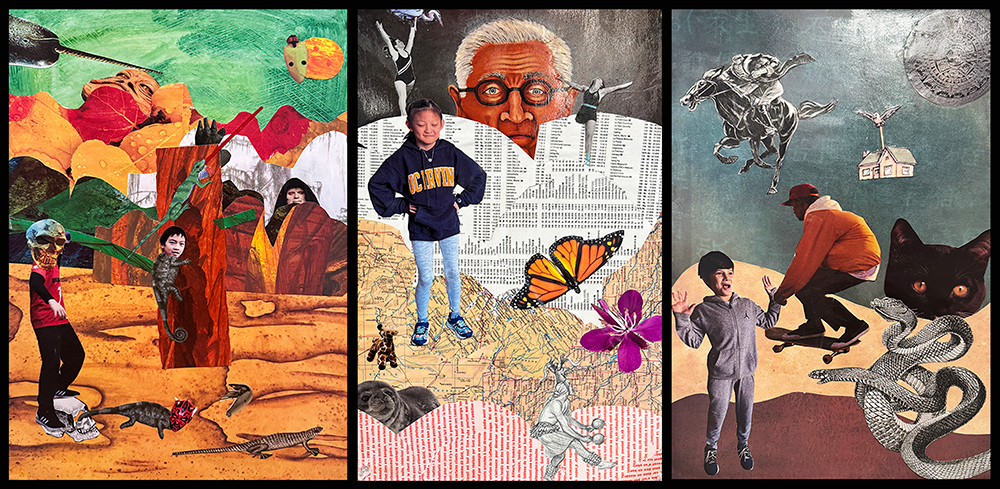
4th Grade Surrealist Collage

4th Grade Surrealist Collage

Description of the Unit – Observing the work of several Surrealist collage artists, like Julien Pacaud, students will learn about the meaning of the term Surrealism, and how it is used in collage art. They will then go on to create their own weird, wild and wonderful collages, using varied sources such as books, magazines, and hand-made paper, while also including an image of themselves within the composition.
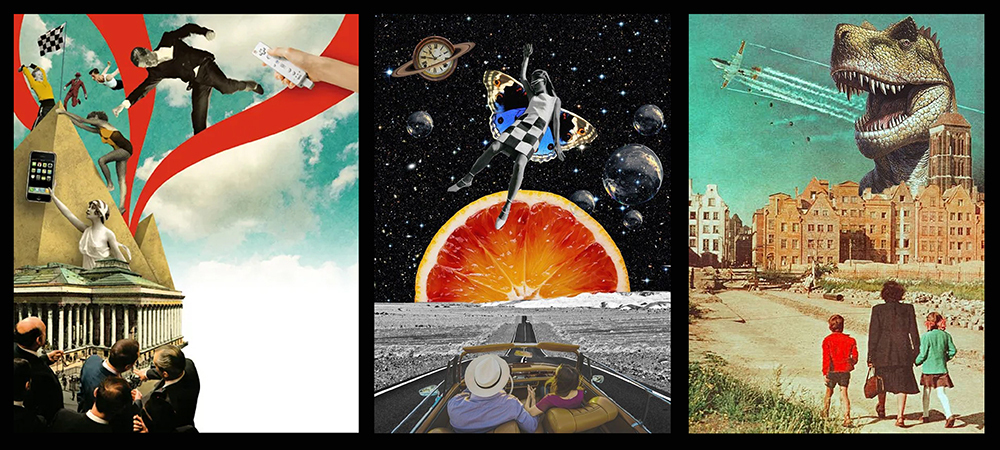
Surrealist collages by Julien Pacaud, unknown, and Ayham Jabr
Surrealist collages by (l-r): Julien Pacaud, unknown artist, and Ayham Jabr
Continue reading “4th Grade Surrealist Collage”
6th Grade – Frank Stella, Protractor Series Designs

6th Grade – Frank Stella, Protractor Series Designs

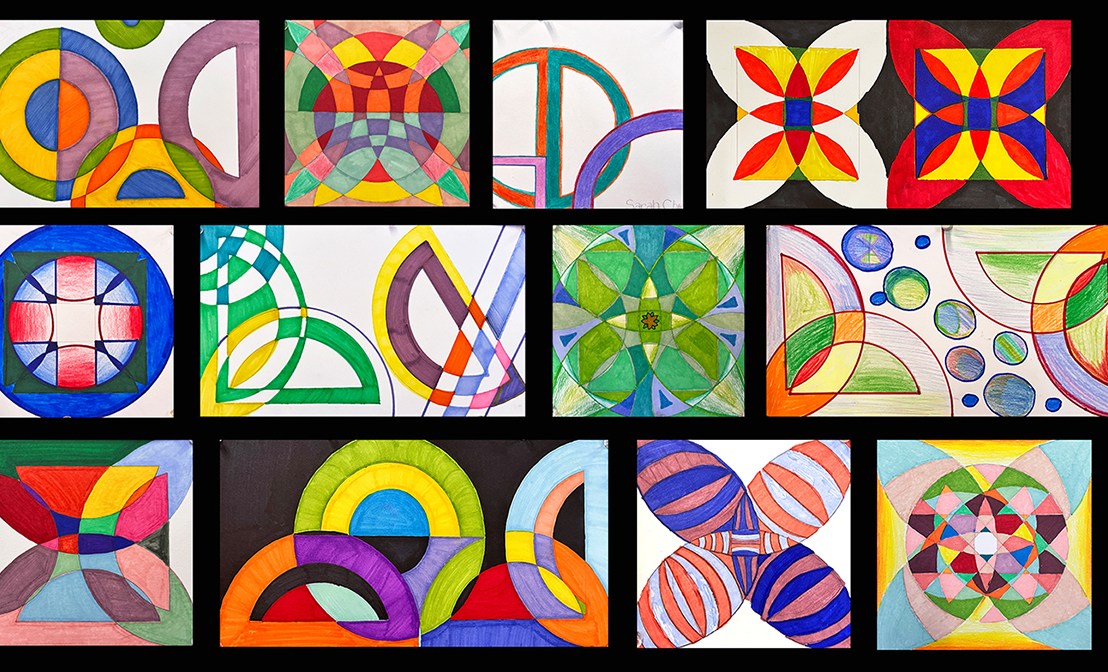
Description of the Unit – Students will observe and discuss the work of Frank Stella, focusing particularly on his Protractor series, and will themselves use a protractor to create designs inspired by this series.

Continue reading “6th Grade – Frank Stella, Protractor Series Designs”
Kindergarten – Picasso’s Dog Lump

Kindergarten – Picasso’s Dog Lump

Description of the Unit – It’s a fun experiment to introduce students this young to the concept of multiple perspectives. To approach this concept in a playful way, students created a Picasso-inspired oil pastel illustration of his beloved dog Lump.

Continue reading “Kindergarten – Picasso’s Dog Lump”