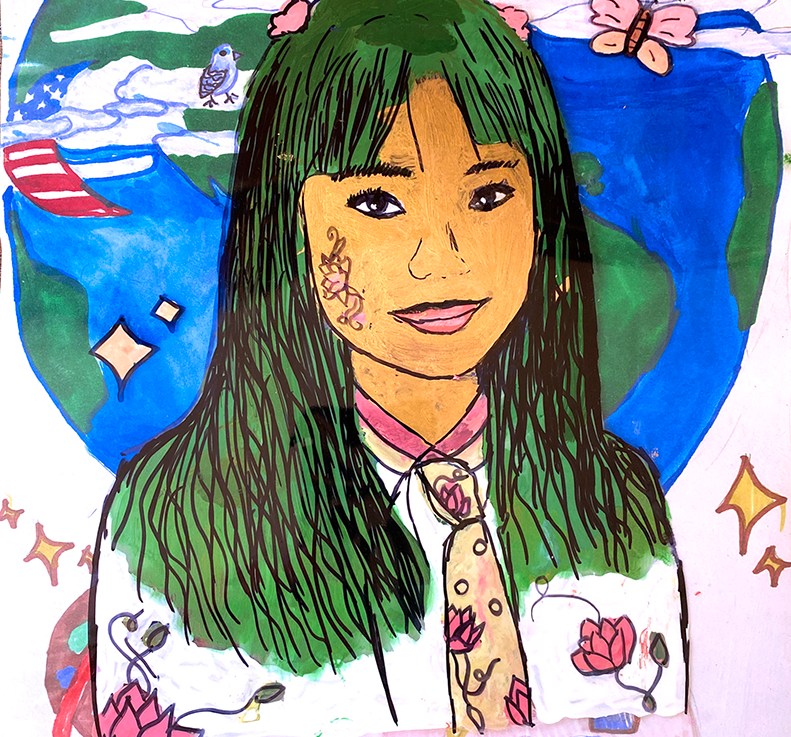
Description of the Unit – Students observed and discussed the work of contemporary American painter Chuck Close, a technically innovative artist known particularly for his large-scale photo-realist portraits. Students applied Close’s use of a grid to break down a self-portrait into individually colored squares that together create a cohesive whole.
Description of the Unit – Students will observe and discuss the work of Frank Stella, focusing particularly on his Protractor series, and will themselves use a protractor to create designs inspired by this series.
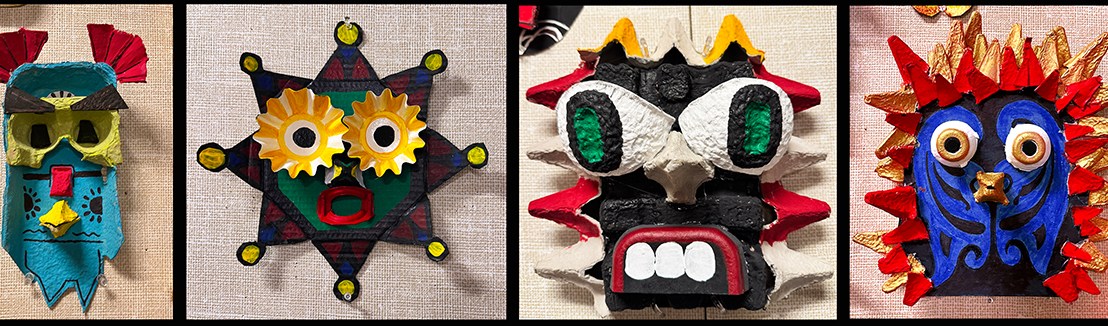
Description of the Unit – Students explored the interesting history and dramatic artistry of masks of First Nations people of the Pacific Northwest. Taking inspiration from the colors and patterns observed in these masks, students made their own masks primarily using…egg cartons!
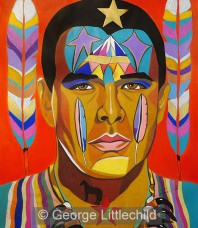
Description of the Unit – Students will create fantastical, energetic self-portraits inspired by the portraits of George Littlechild. Students will use a mix of sharpie markers, colored pencils, watercolor and acrylic paint for their portraits.
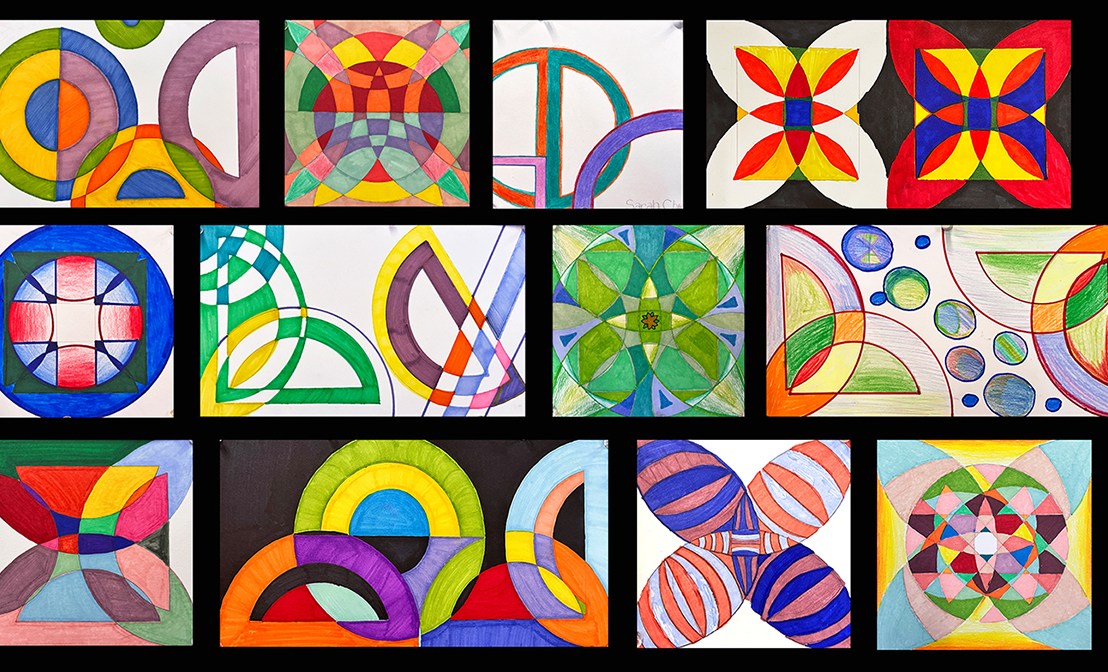
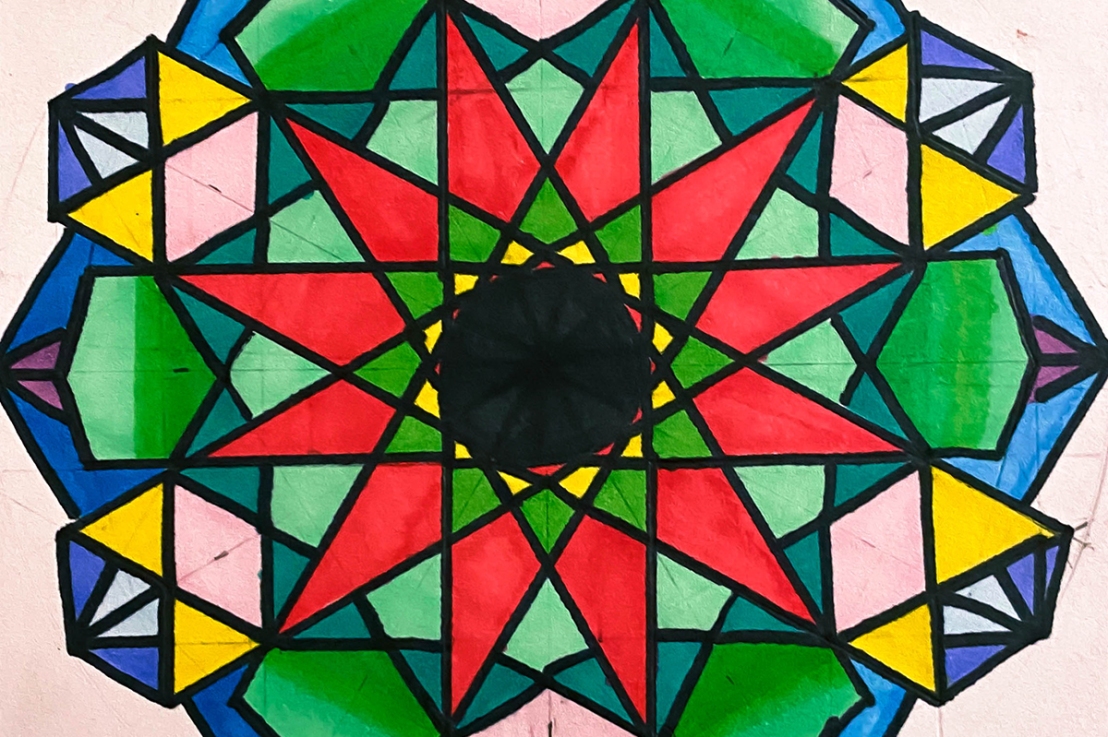
Description of the Unit – Students will explore the centuries-old geometric patterns found in Islamic architecture. Students will use mathematical techniques as instructed in Eric Bourg’s marvelous book, Islamic Geometric Patterns, to re-create a variety of the patterns they have explored through their observations.
Examples of my 6th grade students’ Islamic geometric ’tiles’ elaborated from steps given in Eric Bourg’s book Islamic Geometric Patterns.
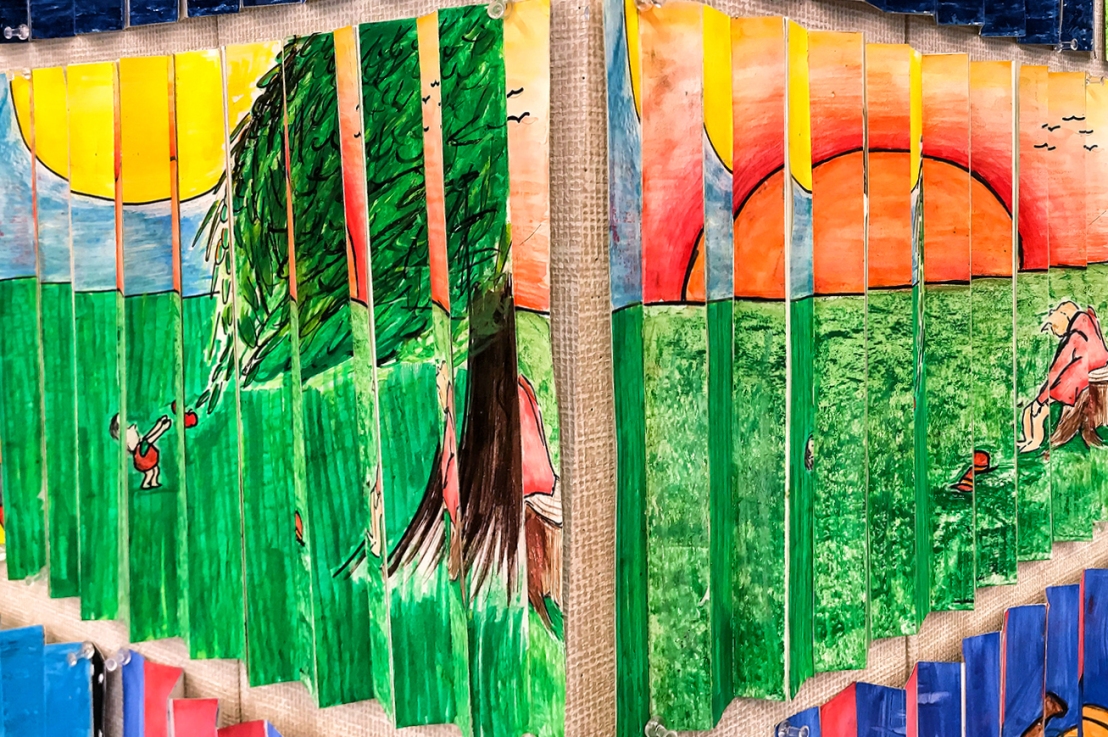
Description of the Unit – Students will examine and discuss the work of artist Yaacov Agam, and through his inspiration they will create their own Agamograph, a kinetic work of art that transforms from one image to another, depending on the viewers’ perspective.
The kinetic Dizengoff Square Fountain by Yaacov Agam
Activity statement – Yaacov Agam is an Israeli artist best known for his pioneering Kinetic Art. His lenticular prints, or Agamographs, made illusory images appear depending on the audience’s viewpoint. These pieces ask one to contemplate change, progress, time, and our role as observer vs. participant. Students will consider images of concepts, creatures or objects which can shift or change in some way, and incorporate their chosen concept into an Agamograph. To successfully create an Agamograph, students will need to make precise mathematical measurements throughout the entire process. Students will have the choice of coloring in their Agamographs in marker, colored pencil, oil pastel and watercolor (for backgrounds)—or a combination of any or all of these media.
The artist Yaacov Agam demonstrating the fluid changeability of one of his kinetic art pieces. Yaacov Agam’s tribute to victims of the AMIA bombing“Visual Prayer for Peace, Hope and Tolerance” by Yaacov Agam
Goals – Students should…
Understand:
The meaning of kinetic art
What an Agamograph is and does
Know:
Who Yaacov Agam is, and the kinds of concepts he explores in his kinetic artwork
Be able to:
Use a ruler to make precise measurements
Think in fractions and apply fractions to paper
Visualize the process of change between two separate images in order to create an Agamograph
Resources and Materials –
Examples of Yaacov Agam’s work, as well as examples of student Agamographs
9×12 white heavyweight (Bristol) paper
12×18 lightweight white paper
Pencils
Erasers
Sharpies (fine and thick point)
Rulers
Colored markers
Colored pencils
Oil pastels
Watercolor
Brushes
Jars
Cutting board
Questions – (first few questions pertain to observing Agam’s work)
What do you notice? What is happening?
How do you think this work is created?
What could the idea of kinetic art symbolize?
What deeper meaning might there be to kinetic art?
What makes kinetic art interesting?
How do you feel about being able to interact with the work of art?
How does this make it different to viewing a static work of art?
What kinds of things can you imagine that transform?
Give examples of two different beings, objects or concepts that can represent a transformation (ie, caterpillar to butterfly, egg in a nest to bird, daytime landscape to nighttime landscape, etc.)
Evaluation – Did students:
Come up with a concept that represents change/transformation?
Successfully construct an Agamograph to represent this transformation?
Informal:
Student questions
Group discussions
Oral responses to essential questions
Elaboration and risk-taking
The following are video representations of 6th grade students’ Agamographs:
The following are photos of 6th grade student Agamographs displaying both sides of each piece:
6th Grade Student Agamograph – Transformation from an otter to an otter skeleton6th Grade Student Agamograph – Transformation from a common rat to Mickey Mouse6th Grade Student Agamograph – Transformation from the Batman searchlight to Batman6th Grade Student Agamograph – Transformation from the little boy to the old man inspired by Shell Silverstein’s “the Giving Tree”
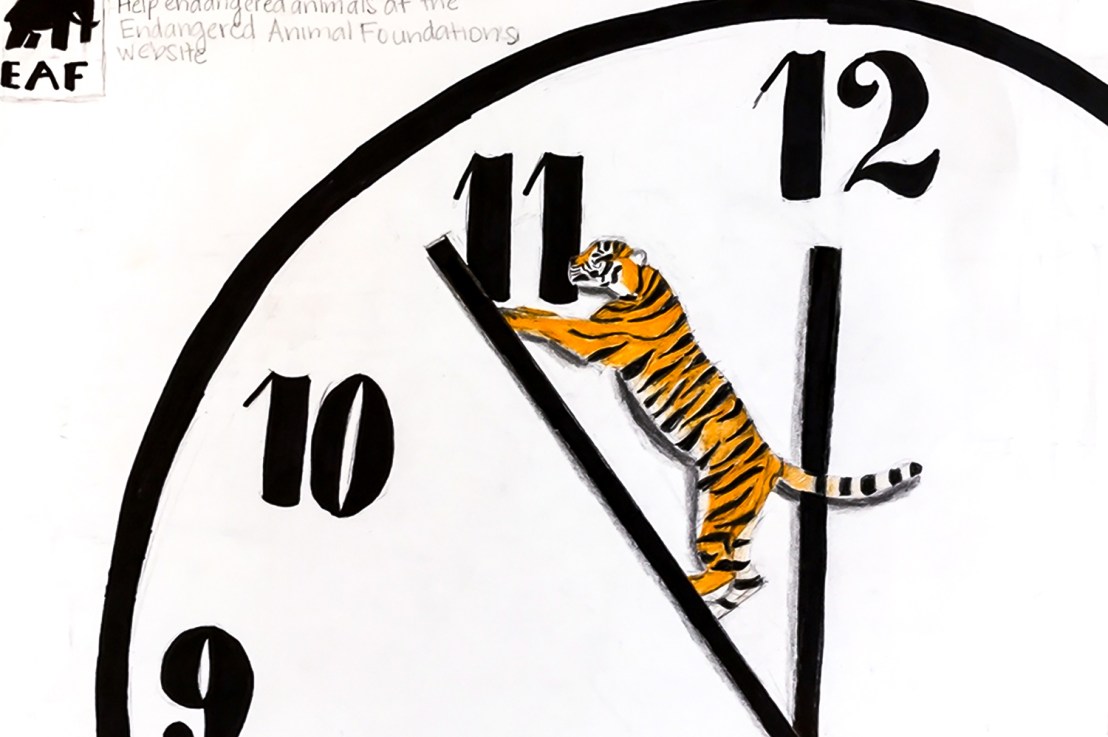
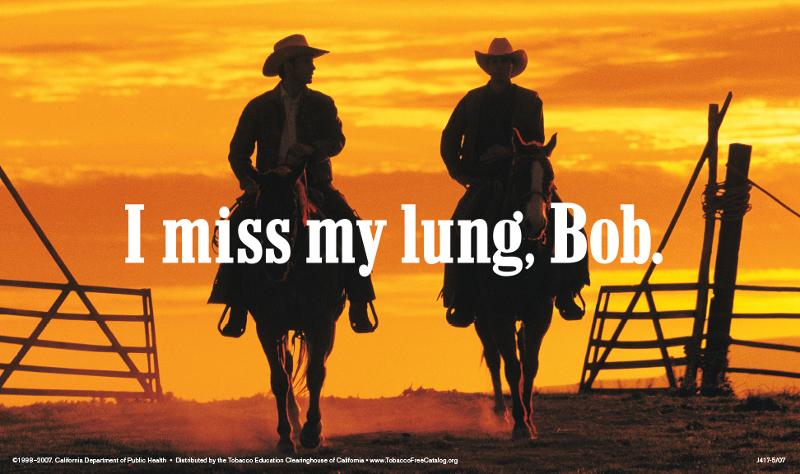
Description of the Unit – Building upon what students learned in 5th grade about product advertisement in print (https://anitasagastegui.com/2020/07/27/5th-grade-print-advertising-and-cultivating-visual-literacy/), students in 6th grade will look at ads from NGO, nonprofit and charitable organizations to examine how imagery and elements of design are used to sway people to a particular cause. It is interesting to go back and look at the 5th grade product advertisements, comparing them to the 6th grade NGO ads. Reinforcing and reviewing what they studied last year has helped to make the nonprofit ads all the more visually dynamic and sophisticated, as you can see. Students will work in groups to create a non-profit organization of their own, complete with mission statement and logo, and one advertisement aimed at convincing viewers to donate or work for their organization’s cause. To test the ads’ effectiveness, we will have a contest between the groups, with faculty, as well as students in 3rd-8th grades voting on the most eye-catching and persuasive ad.
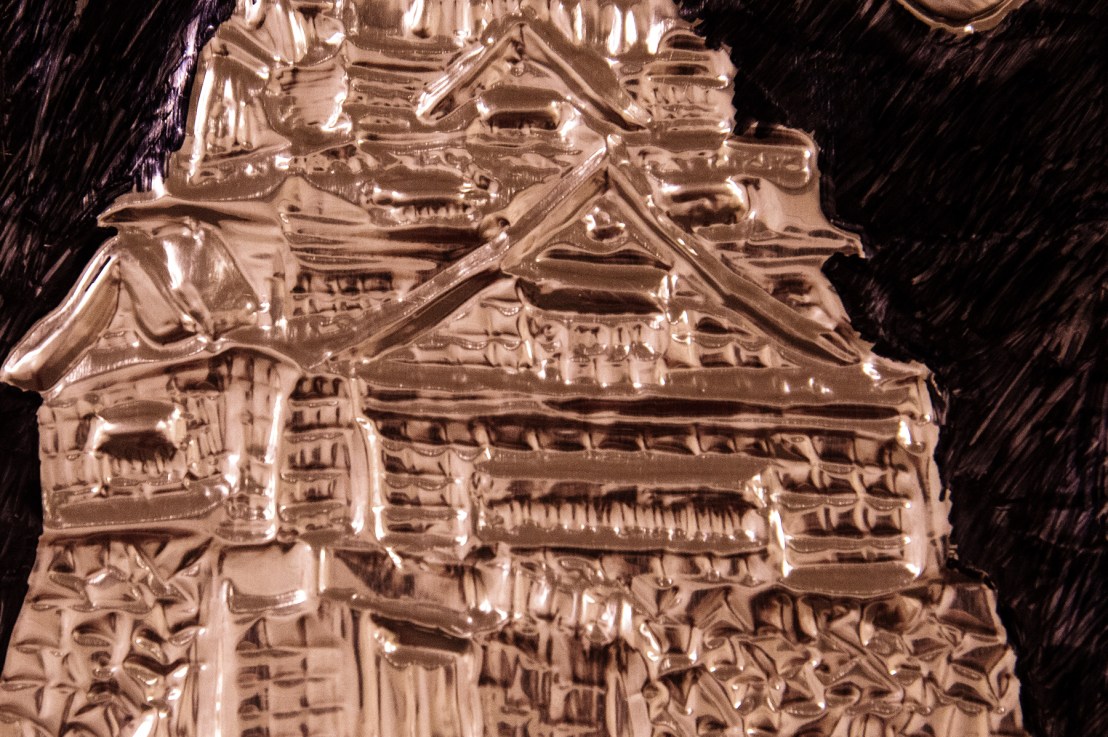
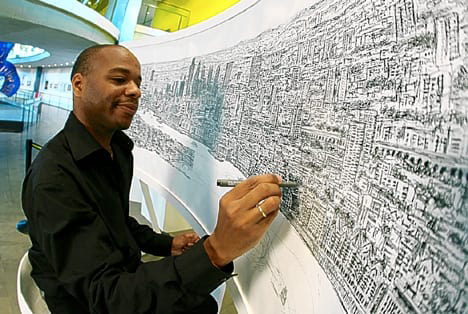
Students will learn about the life and work of artist Stephen Wiltshire. Using his incredibly detailed drawings of buildings and cityscapes, students will create a mini architectural drawing that they will then transfer onto foil.
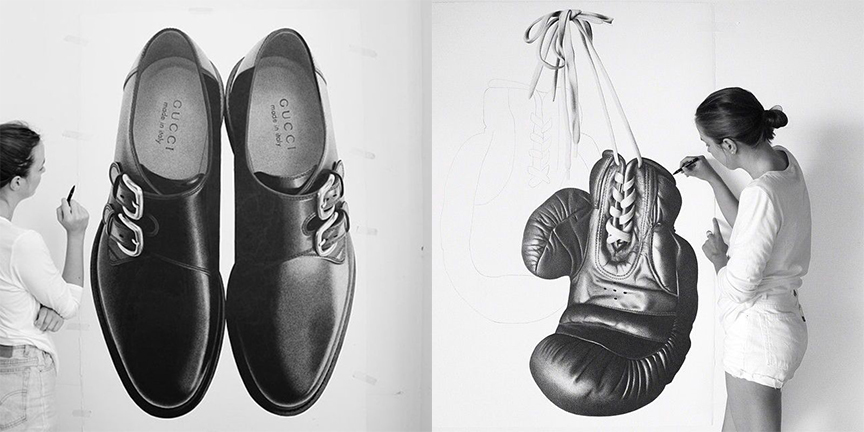
We begin by diving into the fascinating art of CJ Hendry. Hendry expresses having no formal art training and considers herself “not very creative.” Yet she’s a dedicated, innovative artist whose works are primarily hyper-realistic, large scale pencil drawings of (mostly) luxury objects that sometimes take 200 hours to complete. Working with pencil on paper her pieces are achieved through layers of what she refers to as scribbles. Watching her work (you can see some fun videos of her at work here: https://youtu.be/KB8vc9M4QWs and https://youtu.be/KixMpzhMS-o) students become awe-struck by the way her tireless pencil strokes become such lifelike, more-than-photographic representations of real-life objects. They wonder aloud how she does it, exclaiming that they would love to draw like Hendry. I tell them that this unit will give them a foundation for getting there.
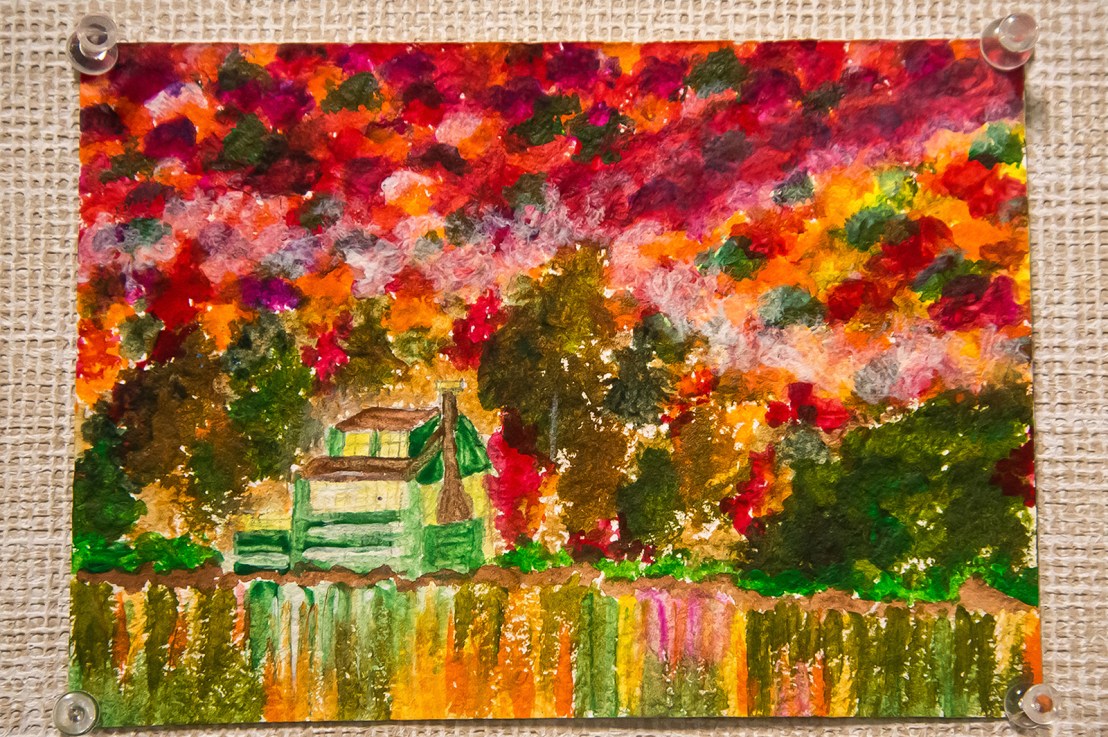
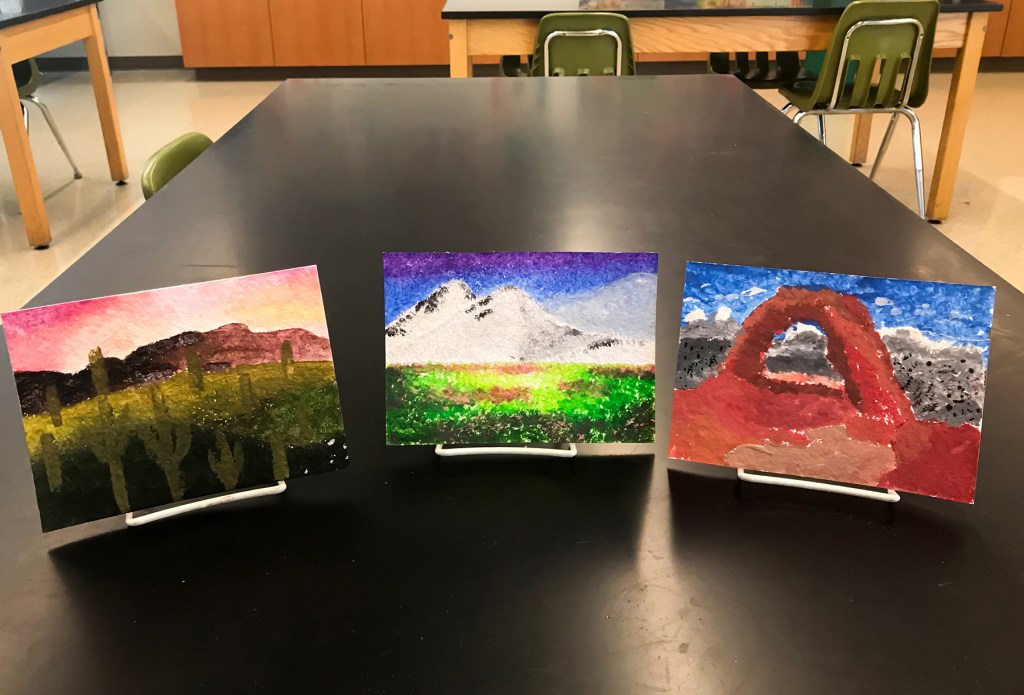
Students will practice a variety of painting techniques (including color mixing and brush effects) for acrylic painting, practicing these for various effects. Students will then choose a nature postcard to use as a reference for their own painting. Students will eventually create at least two different paintings in acrylic of two different nature scenes, trying to use the techniques learned to recreate specific textures and effects.






 In the K-8 Art Studio with Anita Sagastegui