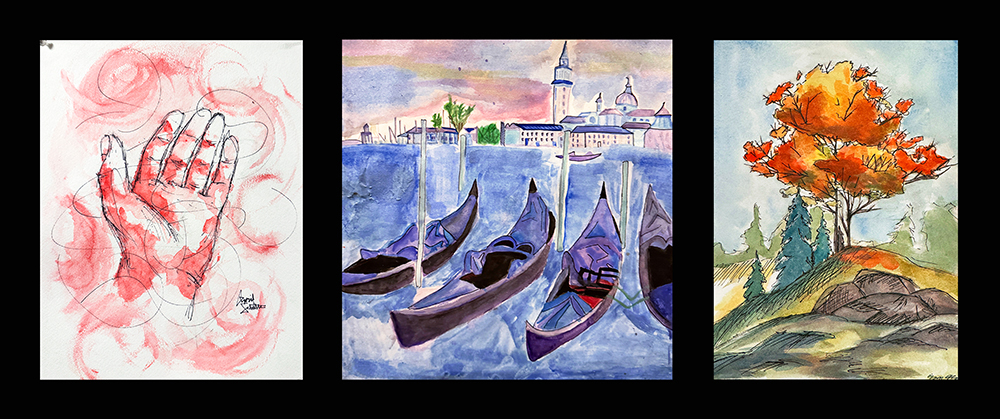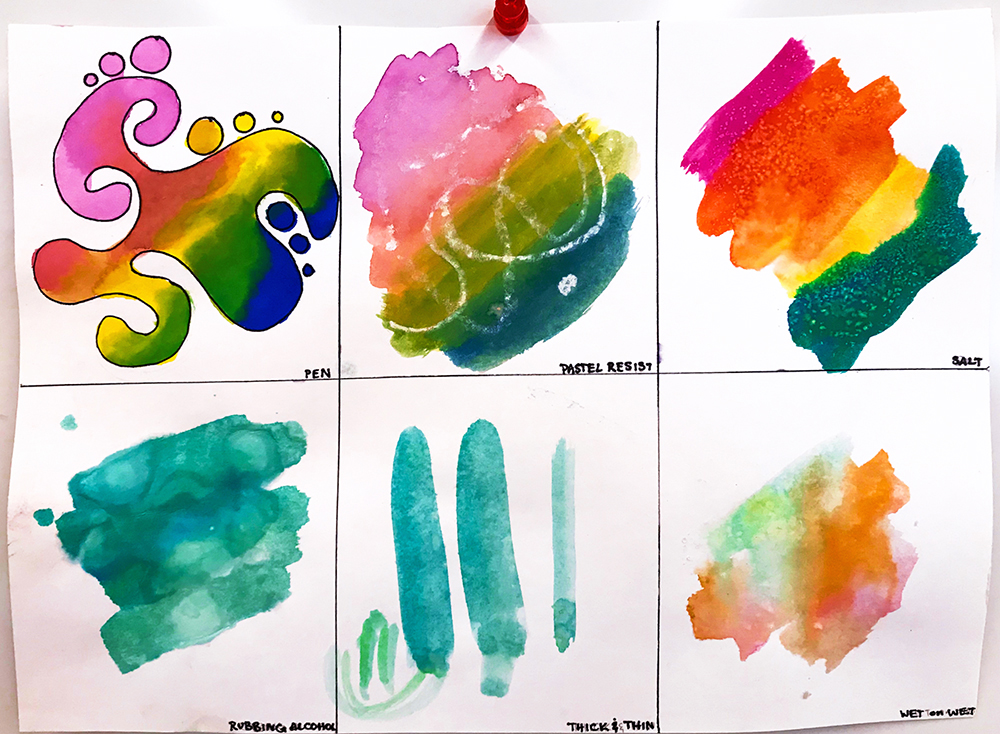
Description of the Unit – This is a purely technical unit that allows students to explore combining watercolor painting techniques with other media.

Lessons for visual art education – where it's about the process, not the product
Tag: curriculum
Description of the Unit – This is a purely technical unit that allows students to explore combining watercolor painting techniques with other media.

Description of the Unit –
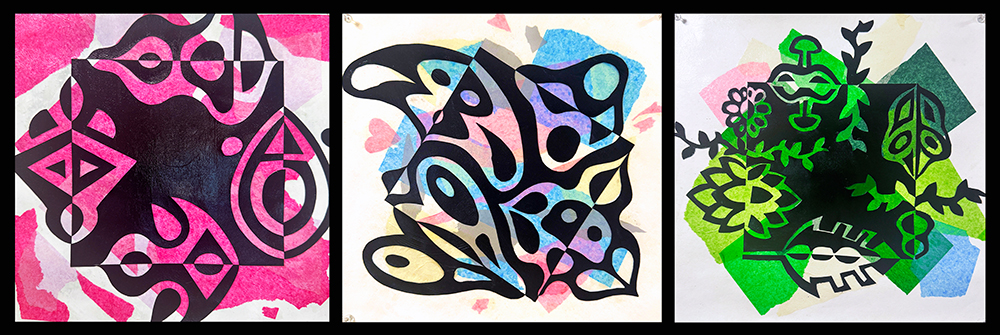
In this unit, students observed the traditional Japanese art of Notan designs, exploring the relationship between positive and negative space between elaborately cut designs, and how this relationship affects composition, balance and symmetry. Students created their own Notan designs.
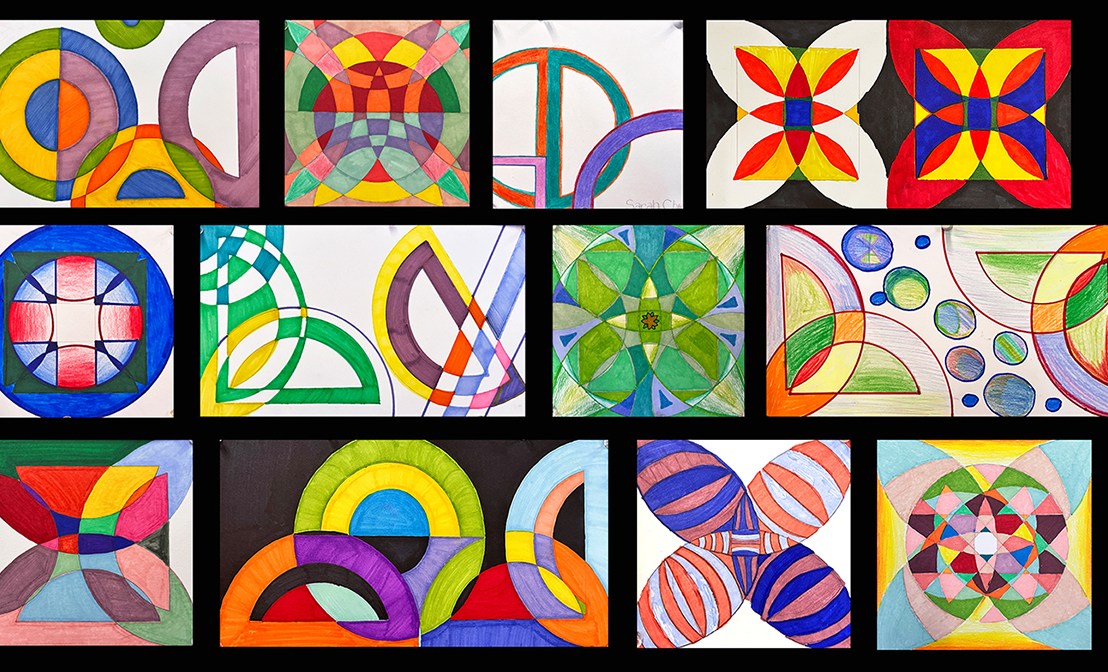
Continue reading “7th Grade – Japanese Notan Designs”Description of the Unit – Students will observe and discuss the work of Frank Stella, focusing particularly on his Protractor series, and will themselves use a protractor to create designs inspired by this series.
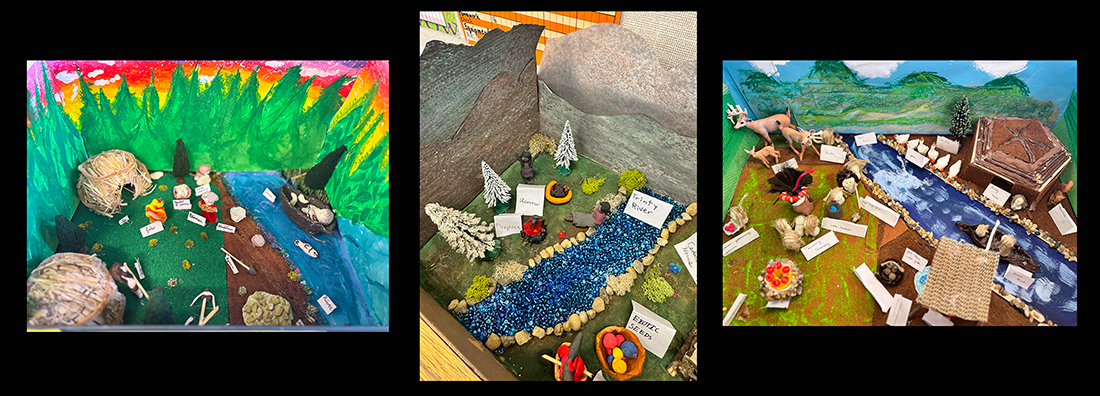
Continue reading “6th Grade – Frank Stella, Protractor Series Designs”Description of the Unit – To support their research of California’s first Americans, students worked in groups to create dioramas representing the lives of a particular tribe (assigned to their group).
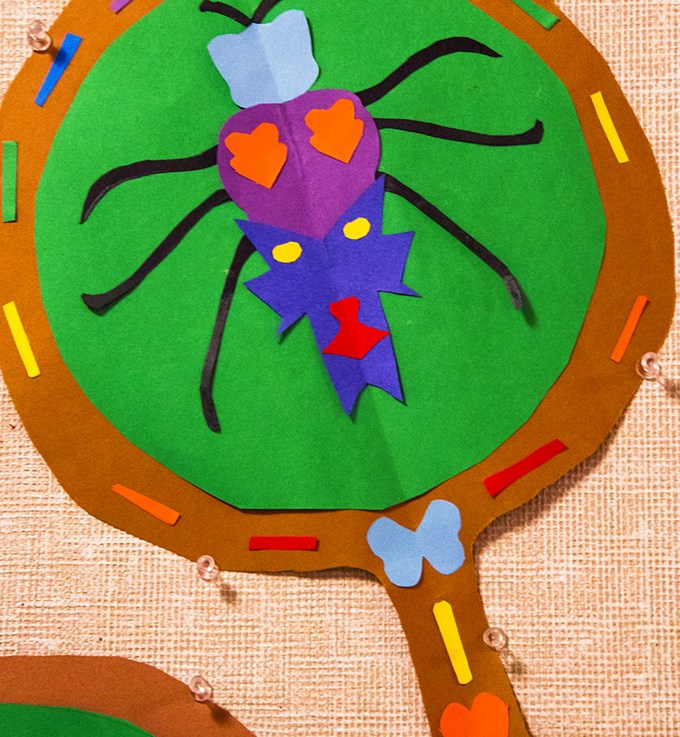
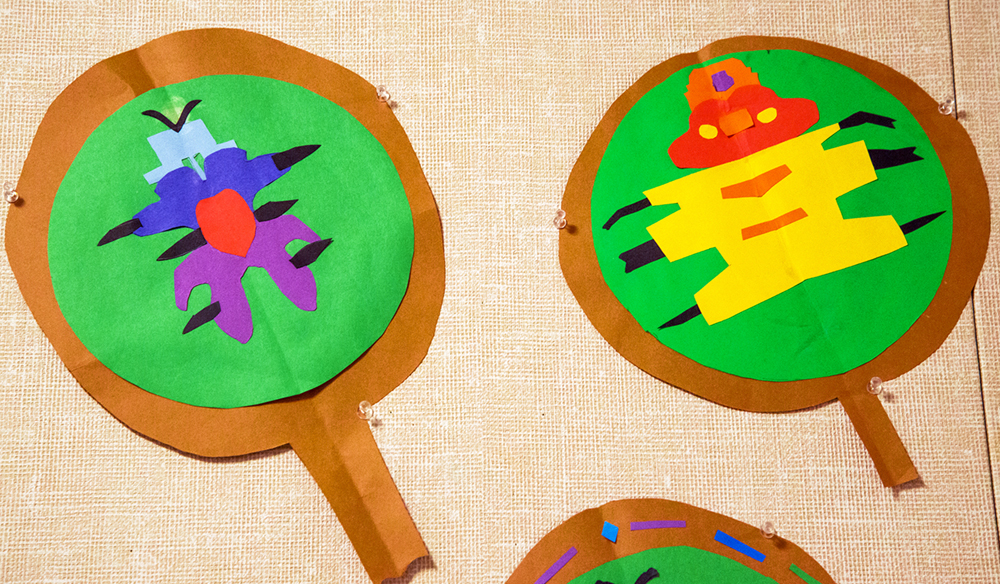
Continue reading “4th Grade – Dioramas of Native Californians”Description of the Unit – A simple yet delightful exploration of symmetry and color, students will create their very own bugs as seen under a “magnifying glass”.
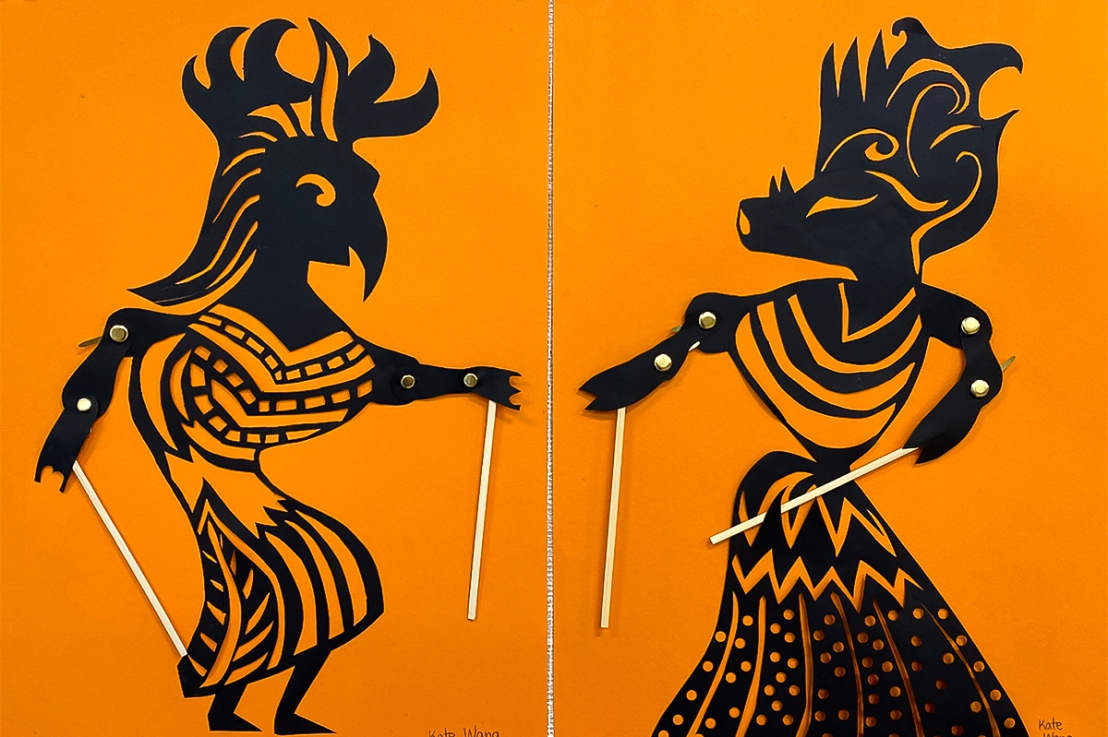
Continue reading “1st Grade – Insects under a Magnifying Glass”Description of the Unit – Students explore the fascinating shadow puppet art form from Indonesia known as Wayang Kulit. Students then create their own shadow puppets, taking particular care to carve patterns on the puppets’ costumes using negative space.
Continue reading “8th Grade – Wayang Kulit Puppets”Description of the Unit – Students will explore the ISO function on their digital cameras so as to understand how it affects exposure, practicing using it and all previously learned functions to take sharp, interesting nighttime photos.
Activity statement – ISO completes the basic triad of camera functions necessary to understand and manipulate your camera in order to get the shot you want. Our objectives are the following:
What is ISO? With analog cameras, ISO represented the film’s sensitivity to light, which was rated via a number, such as 400. The more sensitive the film to light, the higher it’s rating, or number; in photography it was also referred to as the film being “faster”. Film with low ISO was typically used in bright, daytime settings, and so of course the higher ISO’s were used if it was overcast, night, or a darker indoor scene. There was always a compromise, however, as the higher the sensitivity, the grainier the film—meaning the image would actually look grainy and lack sharpness. Additionally, with analog cameras, whatever film sensitivity you were using you would be stuck with until the roll of film was all used.
With digital cameras, one can adjust the ISO at any time. However, if one is not actually using film, why is there still ISO? Well, to the best of my knowledge, when digital cameras first came out manufacturers co-opted ISO to reflect the sensor’s performance level under given light circumstances, so as to give photographers the same options as one once had on analog cameras, when adjusting the aperture and shutter speed just weren’t enough. As with analog cameras, higher ISO’s also produce more noise, however camera technology has been decreasing this outcome over the years.
So, on a digital camera, if your setting is in low light, your preferred aperture and shutter speed might not allow enough light to reach the sensor, and therefore you would need to opt for a higher ISO.
Now that students have had a few weeks to learn about and practice using shutter speed and aperture, I invite them to use them, along with ISO adjustments, to take sharp nighttime images. The images may also involve the use of motion of some kind to blur light. Students should consider either using a tripod, or setting their cameras on a steady surface to reduce the possibility of blur due to handholding the camera.
I love shooting at night, so I give students examples of my own photos and talk to them about the settings I used, the experience I had while shooting each image and what I learned with each.
As always, in class we go on a photo walk to continue to play with our camera’s settings. The nighttime photos will be the assigned homework.
Goals – Students should…
Understand:
Know:
Be able to:
Resources and materials –
Students were assigned the nighttime photography over winter break, so were fortunate enough to take images celebrating the holidays and new year’s eve.
Description of the Unit – When I introduce students to Cbabi Bayoc they often wonder about his “cool sounding” name. Where does it come from? His beautiful name comes from the artist himself. He changed his first name from Clifford to Cbabi, an acronym for Creative Black Artist Battling Ignorance, and, together with his wife, created a new last name for themselves, Bayoc, an acronym for Blessed African Youth of Creativity. Creative he is: Bayoc has worked his way from being a caricature artist at Six Flags in St. Louis to a renowned and sought-after artist commissioned by other notable institutions and artists, including the late musician Prince who commissioned Bayoc to create an album cover for him. Bayoc has also painted school and community murals, and in 2012 he took on one of his most ambitious projects, “365 Days with Dad.” Bayoc painted one painting a day that depicted a positive image of black fatherhood (all while raising his own kids) for the entire year. These uplifting, emotional paintings—such as one of a father swimming with his son, another of a dad reading to his child—has drawn praise from all around the nation, especially within the black community. Bayoc’s work is a testament to the positive influence an artist can have on a community and on the world, and he and his work should be studied and celebrated in our nation’s schools. Please visit his website at: https://cbabibayoc.com/


Activity statement – (Perspective and foreshortening)
One of the techniques that Cbabi Bayoc uses to great effect is foreshortening. I like to use three of his paintings of musicians to explore the mechanism and effect of foreshortening in two-dimensional art: Blues Man, Light Touch, and Serenading the Street. Observing the paintings, one notices how the use of foreshortening works to direct the movement of our eye, and to draw us towards a focal point.


Foreshortening places the viewer nose-to nose with the subject, especially in Bayoc’s work. The size exaggeration in foreshortening brings a sense of immediacy to the moment; we can hear the music being played, sensing the passion and concentration behind the music. Foreshortening in this case makes the action of playing music the true subject of the painting. Bayoc is inviting us to pay attention to the instruments and hands, but more abstractedly, he is asking us to pay attention to the music. In essence, foreshortening is emphasizing the music.
Students also observe the way in which two elements play a key role in how we relate to these paintings. Those elements are color and shape. The colors Bayoc uses are earthy, vibrant and alive, without being overwhelming. Some students have mused that the colors are used perhaps to emphasize warmth, energy and passion.
The features of the body and face are rendered through basic shapes, abstracting the figure somewhat to give us a more animated representation of reality. There’s an immediacy and accessibility to these paintings that seems to be the result of this slight abstract of the humans depicted.
Student work: A Foreshortened Self-portrait – I ask my students: “how can you depict yourself in a situation that requires foreshortening, and make it truly come to life?” This is a challenging project for the students, for in order to express foreshortening you have to have the correct point-of-view. It is important to spend time looking at other images that express foreshortening as well, and I like to pull up images of swimmers, basketball players and martial artists that express foreshortening and non-foreshortened postures to discuss the differences in perspective, point-of-view and distance.

Goals – Students should…
Understand:
Know:
Be able to:
Objectives – Students will:
Resources and materials – (Though not exactly a mixed media piece, I invite students to use any and all media below as they wish)
Questions –
•Topic questions (while observing Bayoc’s work):
•Association questions:
•Visualization questions:
•Transition questions (observing completed work by other students):
Evaluation – Did students:
Informal:
The following are student examples. I apologize for some of the shadows on these photos; we did this unit during the Covid pandemic, so students were at home, and responsible for sending me photos of their work, hence some of the shadows. What I enjoy so much about these pieces is how different they all are, from subject, to media to approach. It was such fun guiding the students through this unit and seeing the resulting artwork.
First, we have work-in-progress:


Next, these are completed artworks:


Description of the Unit – Students will examine and discuss the work of artist Yaacov Agam, and through his inspiration they will create their own Agamograph, a kinetic work of art that transforms from one image to another, depending on the viewers’ perspective.

Activity statement – Yaacov Agam is an Israeli artist best known for his pioneering Kinetic Art. His lenticular prints, or Agamographs, made illusory images appear depending on the audience’s viewpoint. These pieces ask one to contemplate change, progress, time, and our role as observer vs. participant. Students will consider images of concepts, creatures or objects which can shift or change in some way, and incorporate their chosen concept into an Agamograph. To successfully create an Agamograph, students will need to make precise mathematical measurements throughout the entire process. Students will have the choice of coloring in their Agamographs in marker, colored pencil, oil pastel and watercolor (for backgrounds)—or a combination of any or all of these media.


Goals – Students should…
Understand:
Know:
Be able to:
Resources and Materials –
Questions – (first few questions pertain to observing Agam’s work)
Evaluation – Did students:
Informal:
The following are video representations of 6th grade students’ Agamographs:
The following are photos of 6th grade student Agamographs displaying both sides of each piece:


Description of the Unit – Students will conceptualize, design and build props and set pieces for their end-of-year performance. This unit can help anyone who has some kind of event or play to put on and is looking at how students can take full control of the process.
Continue reading “5th Grade – Play Props and Scenery”