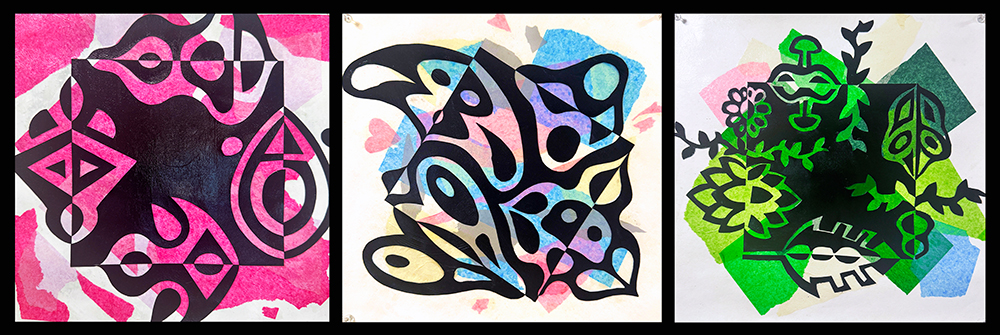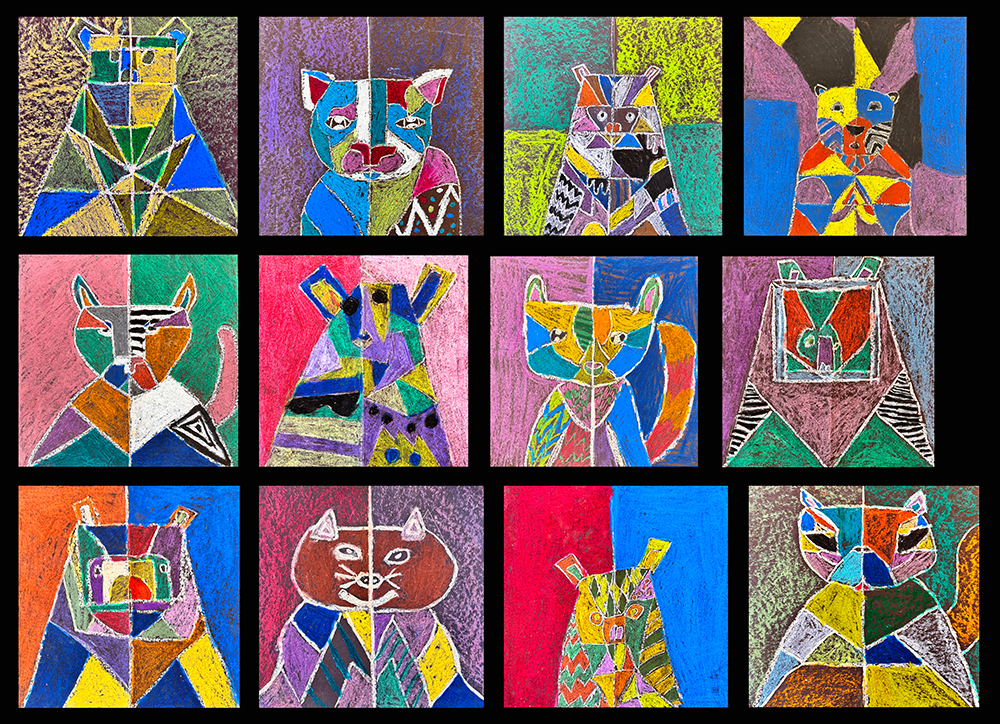
In this unit, students observed the traditional Japanese art of Notan designs, exploring the relationship between positive and negative space between elaborately cut designs, and how this relationship affects composition, balance and symmetry. Students created their own Notan designs.
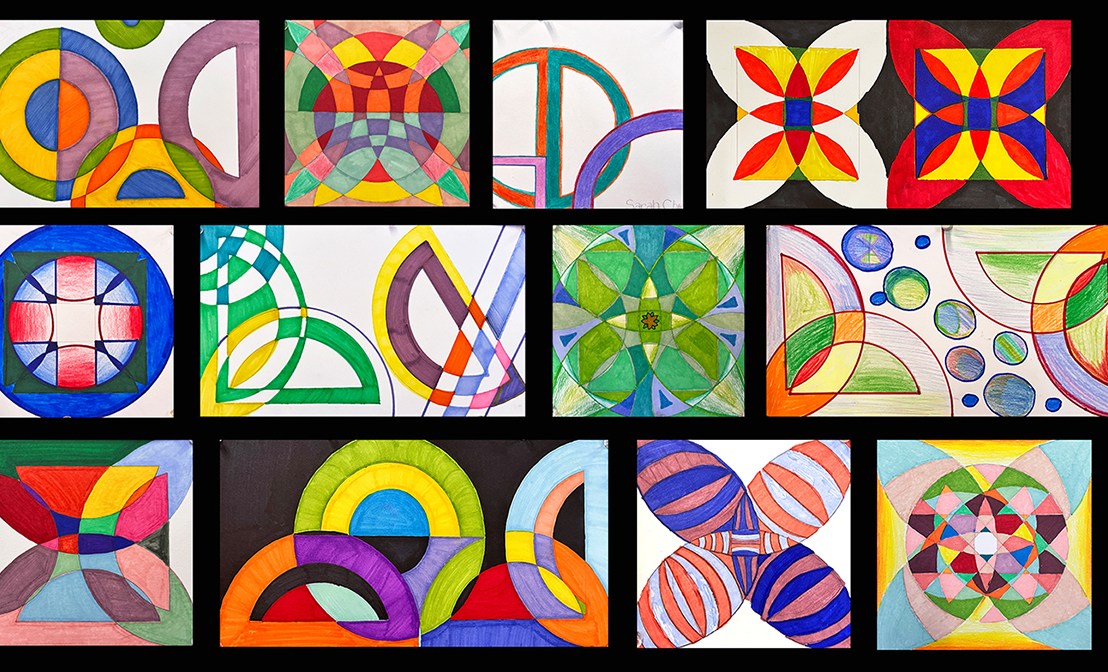
Description of the Unit – Students will observe and discuss the work of Frank Stella, focusing particularly on his Protractor series, and will themselves use a protractor to create designs inspired by this series.
Description of the Unit – It’s a fun experiment to introduce students this young to the concept of multiple perspectives. To approach this concept in a playful way, students created a Picasso-inspired oil pastel illustration of his beloved dog Lump.
Description of the Unit – Second grade students explored Vincent van Gogh’s unique style of painting by observing and then recreating his famous Sunflowers still life.
Students learned about Mexican artist Pedro Linares López and his fantastical, wild Alebrijes, imaginative and colorful papier-mâché creatures that Linares originated. Students created their own Alebrijes out of clay, paint and various objects.
Students will first practice a variety of line drawing, or mark-making, techniques, and then use those techniques to render a landscape or still life in pen.
Activity statement –
Using photographs as a starting point, the objective of this lesson was for students to express changes in perspective, texture and value (light and dark) in a realistic drawing using a variety of lines, such as stippling, hatching, and cross-hatching, as well as varying the lines’ density. In this way they can transform a pen drawing into a realistic representation of a scene in nature. To help in this objective, students first created a mark-making chart expressing different types of lines, and discussed how the different types of lines could be used to represent texture, perspective and value.
Description of the Unit – Emphasizing line and pattern with Jean Dubuffet’s Hourloupe style
According to one of my favorite modern art history sites, the Art Story, “Dubuffet’s L’Hourloupe series began in 1962 and would preoccupy the artist for many decades. The inspiration came from a doodle he created while on the telephone, in which the fluid movement of line combines with limited fields of color to create movement. He believed the style evoked the manner in which objects appear in the mind,” (https://www.theartstory.org/artist/dubuffet-jean/artworks/#pnt_5).
Jean Dubuffet, Banque des équivoques, 1964
Students love to learn about the origin of the Hourloupe series, being surprised at how much can be done with a seemingly simple doodle. They like the notion of trying to find hidden images within the doodle as well.
As students are shown ways to embellish a doodle with a variety of lines and patterns, we are given the opportunity to reinforce their understanding of repetition and pattern (having been introduced in kindergarten and practiced in 1st grade). To be able to identify and practice repetition and pattern is prescribed in most states’ standards for second grade visual arts.
2nd grade Jean Dubuffet-inspired design
As we observe Dubuffet’s Hourloupes, I call students’ attention to his minimal use of color, and have them comment on whether the colors are primary or secondary, and whether they are complementary. Later when making their own designs I have them also choose only a few colors, and have them think about whether they want the colors to be mostly warm or cool.