
This is an exciting, multistep exploration of shape and color inspired by one of my favorite artists, Paul Klee. This unit is an extension of a previous one, which you can see here: https://anitasagastegui.com/2020/06/08/3rd-grade-paul-klees-magic-square-series/. The difference being that this time students are creating mosaic collages rather than drawings, so we emphasize the terms background, middle ground and foreground, as well an understanding of overlapping elements.
Activity statement – In Paul Klee’s “Magic Square” series, the artist creates cityscapes that use rhythmic repetition of lines, (mostly geometric) shapes and colors. Klee was inspired by the architecture he encountered on a trip to Tunisia in 1914. Looking at images of Tunisian architecture I can see how Klee could have been intrigued by the use of both organic and geometric shapes.

The resulting artwork he created in this series plays with the abstraction of buildings into basic geometric shapes dotted with an occasional organic shape. The resulting compositions are balanced and harmonious, with one tone of color (warm or cool) being the primary tone used with areas of contrasting colors deliberately interspersed throughout. The paintings are also very textured, in some instances you can see the canvas’ weave, which I think adds substance to the art work.

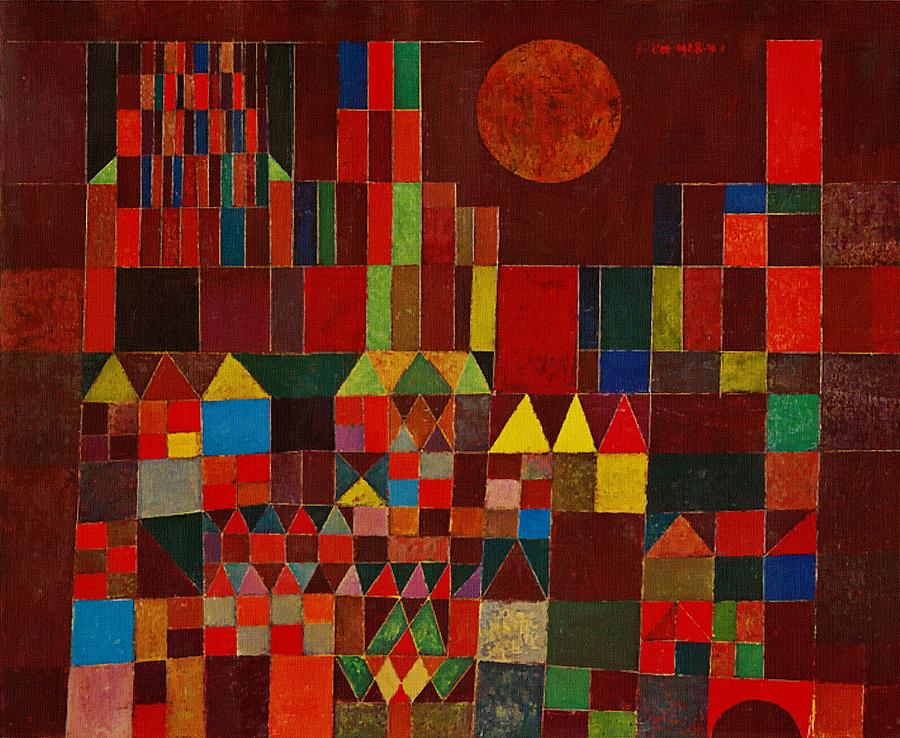
Students observed and discussed several paintings from this series, noting in addition to everything mentioned above, Klee’s use of texture, which gives these paintings a sandpaper like expression. I introduced students to the principles of balance and rhythm while reviewing repetition. We also talked about the perspective in each image, asking students to identify foreground, middle ground and background elements (first by simply asking what they imagine is ‘closest’ vs ‘furthest away.’) This facilitated us being able to discuss how they would go about arranging a mosaic made up of shapes. Remember, when you do this project with your students, make sure they have already rubbed a layer of oil pastel to the strips of paper they will use to cut the shapes. The color of the oil pastel should be more or less the same color as the strip of paper.
Goals – Students should…
Understand:
- Warm colors vs. cool colors
- The difference between organic and geometric shapes
- What is meant by rhythm in a composition
Know:
- What foreground, middle ground and background are
- What it means when a composition is considered ‘balanced’
- The meaning of the term abstract
Be able to:
- Recognize objects in the foreground, middle ground and background
- Plan the collage in order to effectively overlap shapes
- Create a composition of mostly geometric shapes to imply buildings
- Create a textured effect with oil pastels
Objectives – Students will:
- Explore Paul Klee’s Magic Square series
- Discuss what they observe
- Discuss terms important for understanding including warm & cool colors, texture, abstract, balance, rhythm and background, foreground and middle ground
- Apply their understanding of the terms discussed to create their own ‘cityscape’ mosaic
Resources and materials –
- Diverse examples of Paul Klee’s Magic Square paintings
- 12×18 construction paper in a range of colors
- Strips of colored paper in various widths (students will apply oil pastel over each strip using the same color—ie, blue on blue—to give each strip texture)
- Oil pastels
- Scissors
- Glue sticks
Questions –
- What shapes do you see?
- What does this painting mostly have, warm or cool colors?
- What colors are contrasting? What do you think about the colors in these works of art?
- What kinds of real-life objects do the shapes imply? Is this painting realistic? Why or why not?
- Do you see any patterns?
- What do you notice is the same on the right side as the left side? What is different? Are the sides mostly symmetrical?
- What do you notice is the same on the bottom part of the painting as the top? What is difference?
- What objects do you think are ‘closest’ to you? Why? Do you know what that is called?
- What objects do you think are the farthest away? Why? Do you know what that is called?
- Do you notice any repetition?
Evaluation – Did students:
- Understand the difference between warm and cool colors?
- Recognize geometric shapes vs. organic shapes?
- Recognize texture?
- Understand what is meant by foreground, background and middle ground?
- Understand the use of repetition and balance?
- Create their own ‘cityscape’ employing these elements and principles?
Informal:
- Student questions
- Group discussions
- Oral responses to essential questions
- At least one finished piece


 In the K-8 Art Studio with Anita Sagastegui
Such beautiful work! Just gorgeous.