
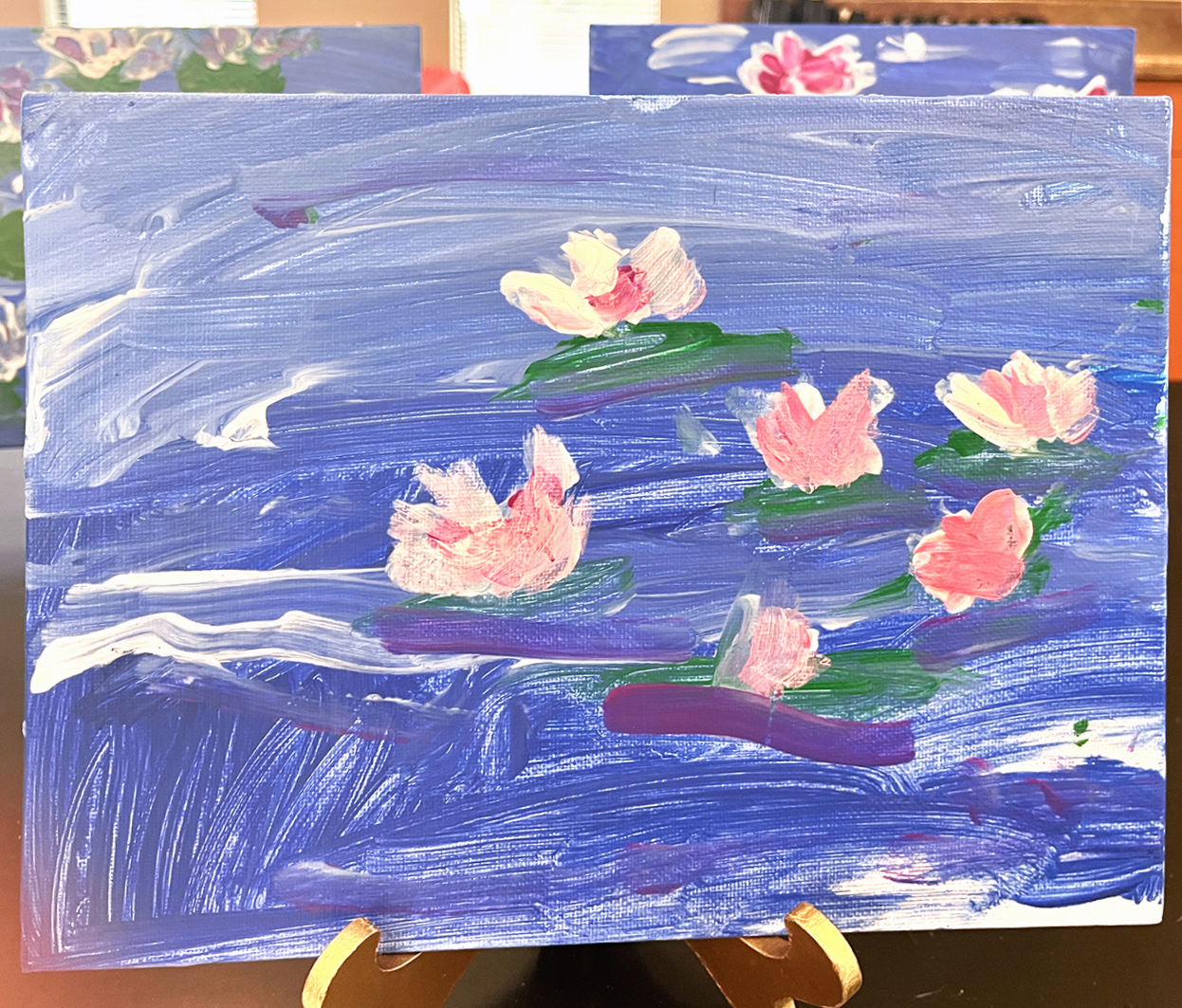
Description of the Unit – Students will be “introduced” to Monet and will learn all about the ways he approached painting the world around him. Students will try to recreate his painting of water lilies, paying attention to their brushstrokes and the colors they choose.

Activity statement – Claude Monet was one of the founders of the Impressionist movement, and throughout his life he assiduously practiced painting his impressions, or perceptions, of the natural world.


My colleague, Willow M., came dressed as Claude Monet himself, and cleverly and entertainingly took on his persona to share stories about his life and the way he paints. The students were utterly mesmerized. They learned that Monet was a fervent plein-air painter (a painter who paints outside) who never sketched out his paintings, instead painting as quickly as possible with thick applications of paint, mindful of the way the sun’s voyage across the sky changed the quality of light. The students also learned that Monet liked using pure, primary, and complementary colors, while disliking the colors brown and black. The students learned that Monet rarely painted a straight line, and instead painted with short, comma-like strokes with thick paint creating an obvious brush texture, deviating from more realistic representations. These are some of the basic ways in which Monet was different from those painters that came before him.
The children practiced creating these types of thick, textured, rounded strokes, much to their amusement.
Willow as Monet then shared his painting titled “Bridge over a Pond with Water Lilies” (1899) and asked the students to express their perceptions and feelings about the painting. The children were invited to practice the strokes as they noticed them in the painting, taking turns on a canvas in front of the class.
Finally, “Monet” shared close-ups of several of his water lily paintings, again inviting the students to express what they noticed. They were introduced to the term texture, though not for the first time this year, so it was more like a reinforcing of the term. I heard students describe “soft colors,” “rough textures,” “wavy” brushstrokes, “colors on top of other colors” and so forth. It was exciting to hear five-year-old children’s observations of Monet’s paintings.
Each child was given a canvas and a limited palette of pure, bright colors, and Willow as Monet guided them through their own painting of water lilies.


Goals – Students should…
Understand:
- (As clear and approachable for a kindergarten student) the ways in which Monet liked to paint, and why this made him different form painters before him.
Know:
- What the three primary and three secondary colors are.
- What the term texture means.
Be able to:
- Practice short, gestural brushstrokes.
- Play with the brushstrokes to create thick, brushy textures.
Objectives – Students will: practice applying short, textured brushstrokes in pure, bright colors as they attempt to create their own water lilies painting.
Resources and materials –
- Examples of Monet’s paintings
- Canvas
- Paint
- Paintbrushes
- Cups for water
- Paper towels
- Aprons
Questions –
- What do you notice about (X) painting? Does it look realistic to you? Why or why not?
- How would you describe the colors?
- How would you describe the texture, or feel, of (X) painting?
- Can you move an imaginary brush the way you think Monet painted this painting?
- Do you like this painting? Why or why not?
Evaluation – Did students:
- Practice gestural, short brushstrokes?
- Practice thick applications of paint?
- Layer pure colors over one another?
Informal:
- Student questions
- Group discussions
- Oral responses to essential questions
- Elaboration and risk-taking
- One complete painting


 In the K-8 Art Studio with Anita Sagastegui