

Description of the Unit – A great project to support math skills, students will create woven geometric patterns. This project is so satisfying and so beloved by my students, that often they beg to extend the unit for weeks, and some would rather we only did this the rest of the year! They all end up taking home at least four different designs.
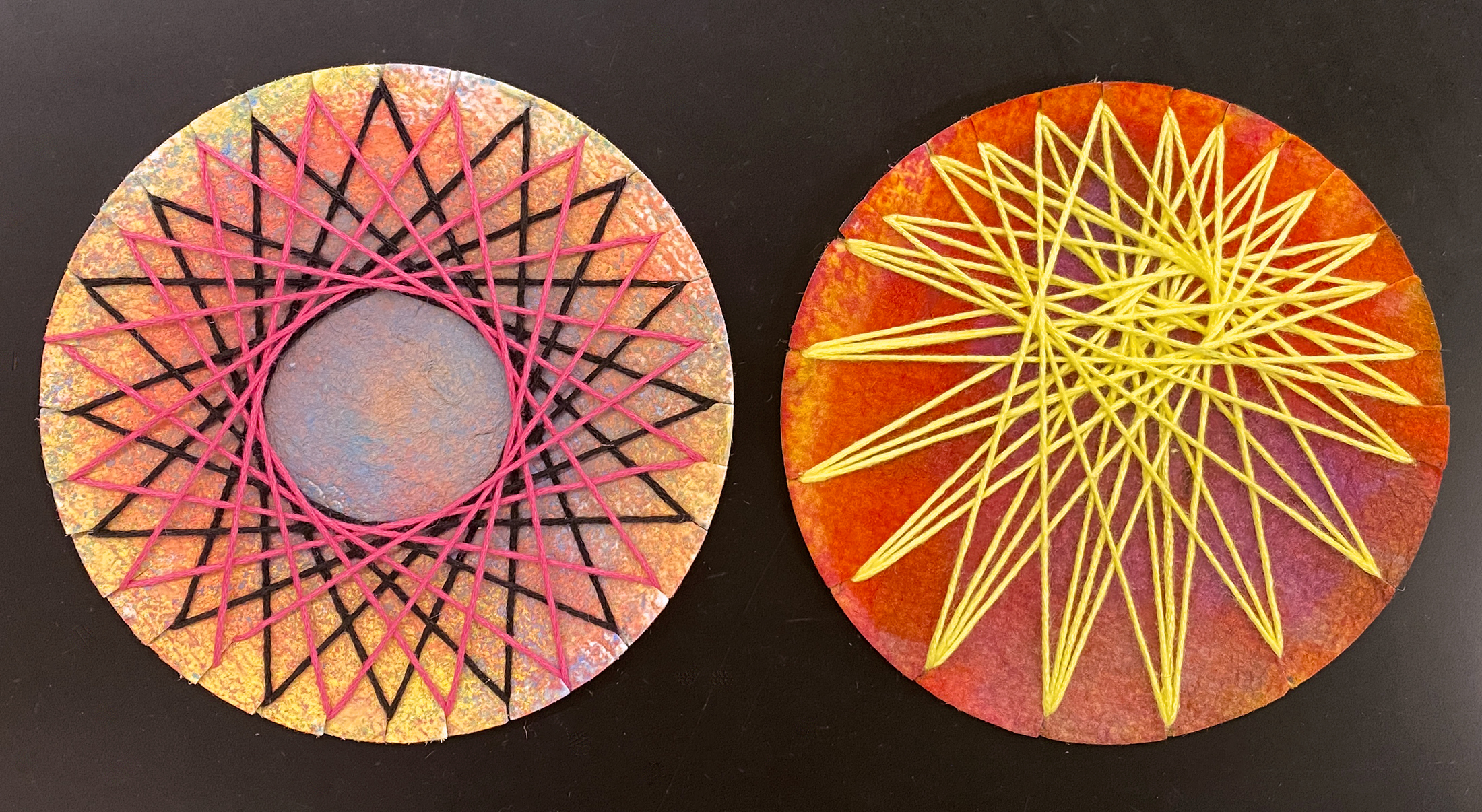
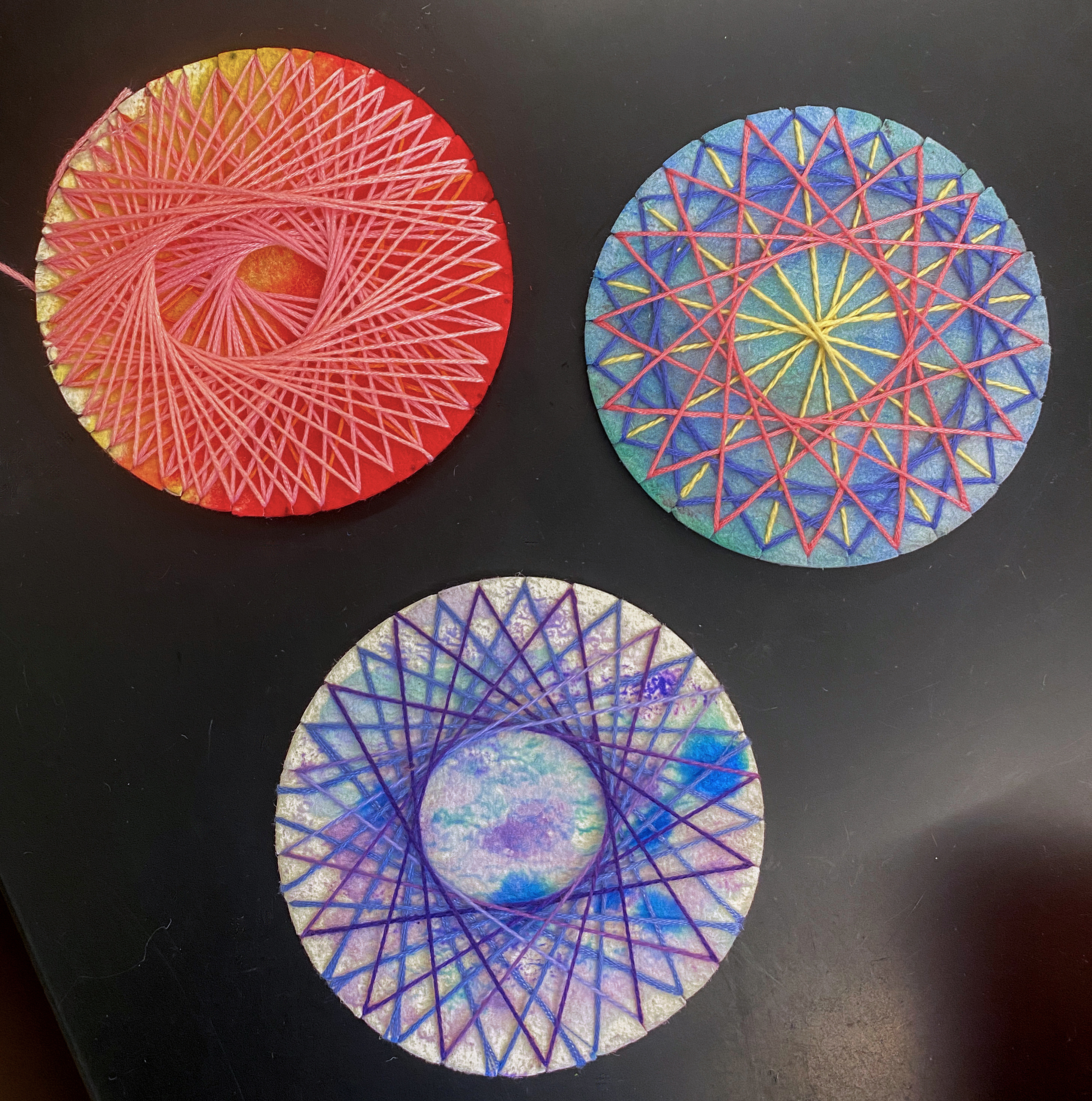
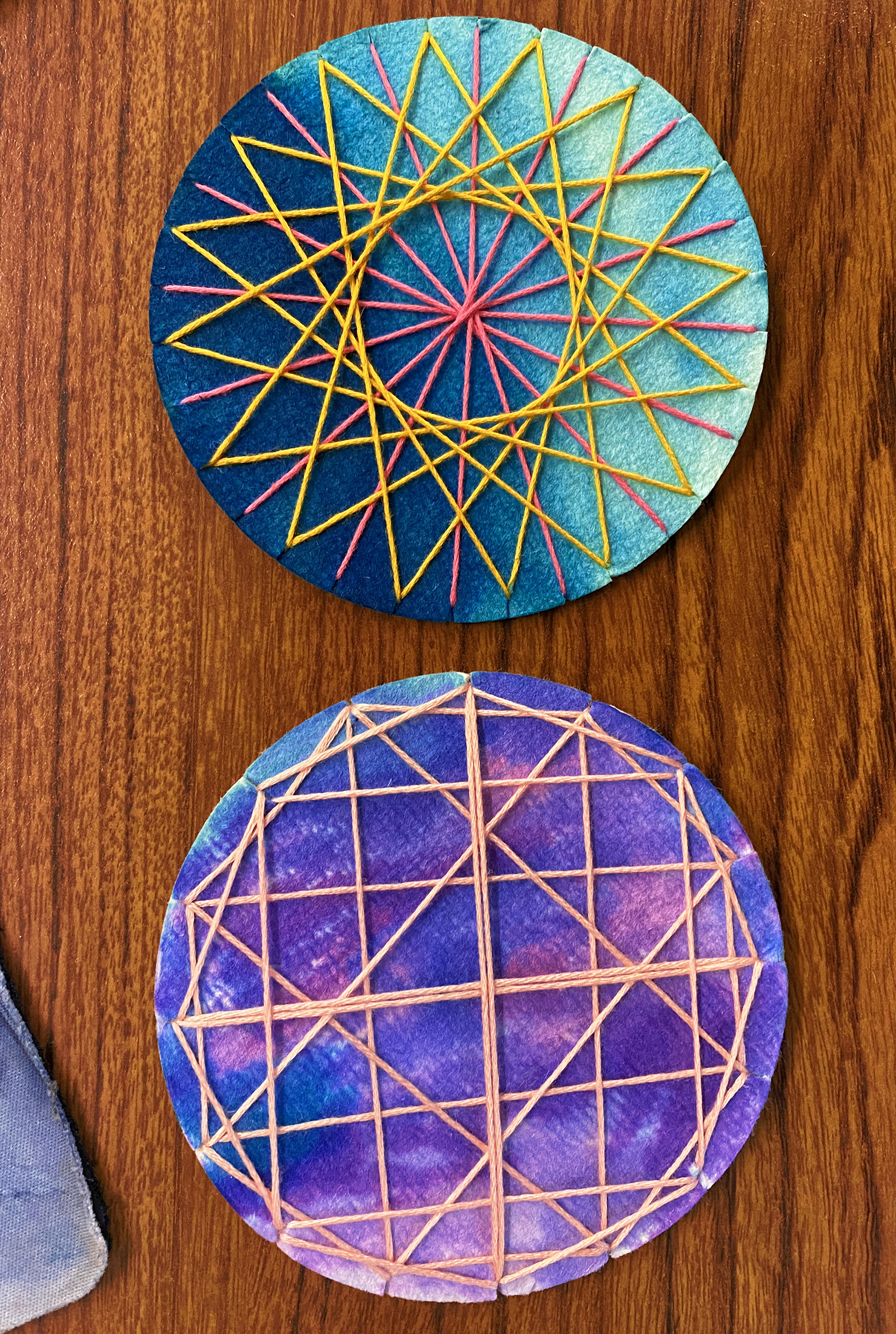
Activity statement – For this unit, students will be using protractors to measure notches in a circle that will support a mathematical woven pattern they will then weave with embroidery thread. We will start with one basic design, but then students will be invited to elaborate other designs as well using their understanding of angles and degrees around the diameter of a circle (for example, what degree/angles do you need to create a pattern of squares?). Students will mathematically draw a geometric pattern, in as many colors as they choose, that they will then use as their model for the same pattern woven into the cardboard coasters. For a little bit a fun, and to add a contrast to the linear aspect of the project, the cardboard background will be painted by the students so that they may include organic texture designs and complementary colors that set off their geometric pattern.
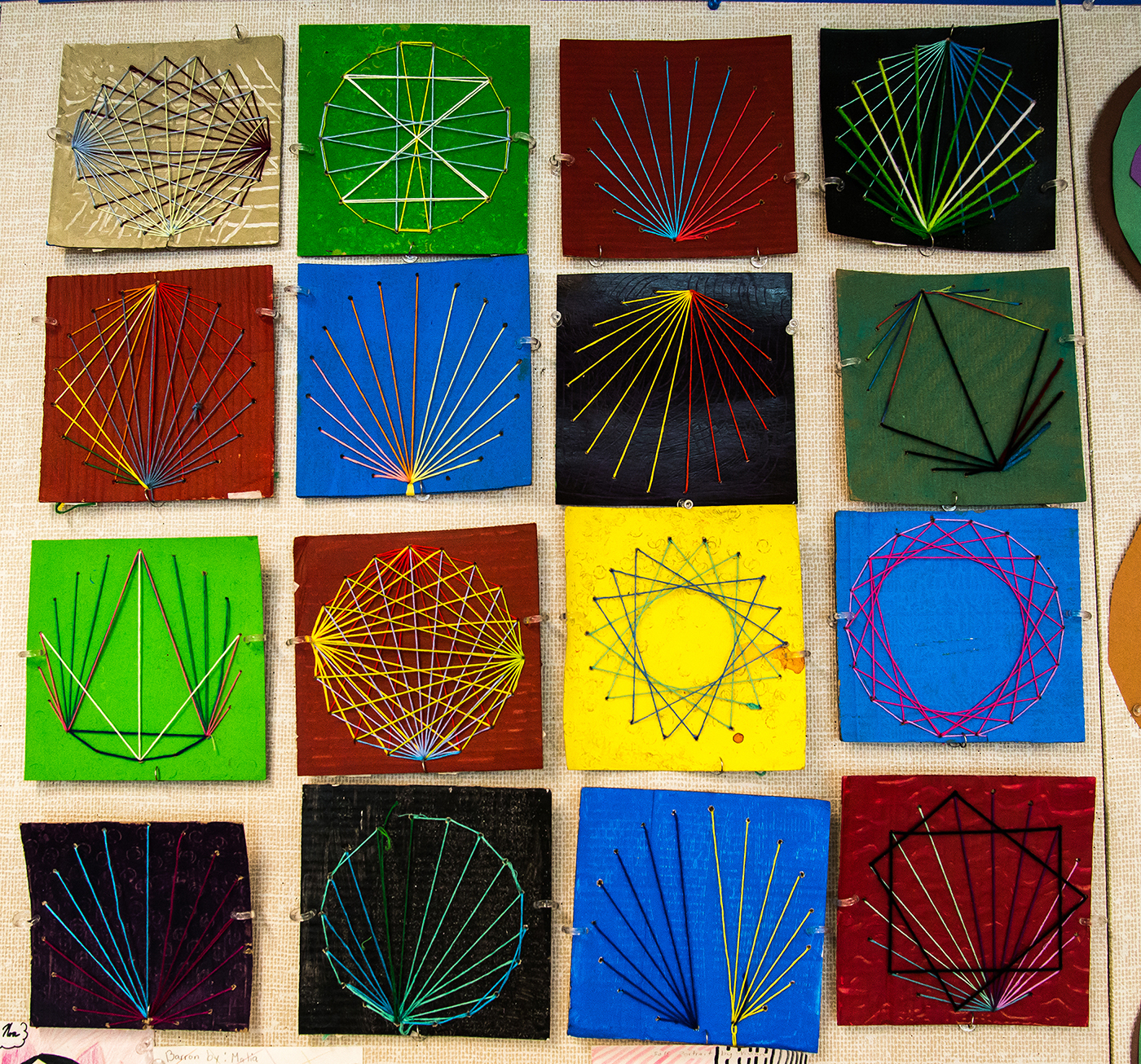
We created some patterns with circular coasters, while others we elaborated on squares, creating circular patterns within the carboard square.
Goals – Students should…
Understand:
- Techniques for approaching a geometric string pattern (rotating lines, rotating squares, rotating triangles, etc.)
- The use of a protractor for determining angles and degrees
Know:
- How to divide a circle into 18 equally spaced segments (as a starting point, but not limited to 18)
- How to weave a basic pattern
Be able to:
- Use a protractor to measure 18 equal sections within a circle (as a starting point, but not limited to 18)
- Use a protractor to create other designs
- Create at least one string pattern design (Ha, this is funny, really. All my students end up making at least four)
Resources and materials –
- 4” Protractors
- 4” Cardboard coasters
- Pencils
- Erasers
- Paint
- Tools that can make textures on paint
- Multicolored embroidery thread
- Scissors
- Cardboard squares for a different take on the project
- One or two examples of patterns
Questions –
- How do you divide a circle into 18 segments?
- How can you begin to design a pattern within this circle?
- How do you form a simple weaving pattern?
- Can you think of what angles you could use for a pattern of triangles?
- Can you think of what angles you could use for a pattern of squares?
Evaluation – Did students:
- Intentionally practice different designs?
- Create a thoughtful, intricate pattern?
Informal:
- Student questions
- Group discussions
- Oral responses to essential questions
- Elaboration and risk-taking



 In the K-8 Art Studio with Anita Sagastegui
I used to make these all the time. I believe my family got sick of me giving them as gifts. I realize this is an older post but I’ve had it saved for quite a while I was curious what educational material you used to teach the kids about the angles of the circle and how to come up with the pattern.
Thank you,
Lori
Thank you for your interest in this unit, Jessica! (It reminds me I need to add our most recent photos of this unit, as the kids make the most interesting designs!) To answer your question, we start with a basic design that uses a protractor on the coaster to measure 30° increments all the way around. As they become more skilled in their designs the students will use the protractor for a variety of measurements. Some get quite intricate, making notches every ten degrees! I hope this helps! Let me know how it goes. ~Anita