Description of the Unit –
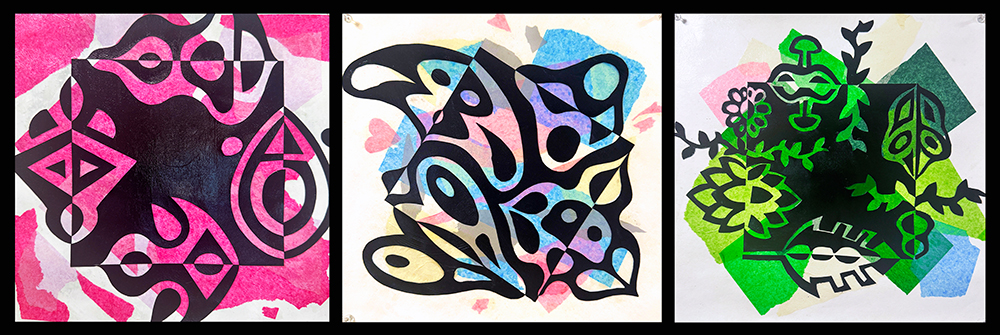
In this unit, students observed the traditional Japanese art of Notan designs, exploring the relationship between positive and negative space between elaborately cut designs, and how this relationship affects composition, balance and symmetry. Students created their own Notan designs.
Activity statement –
Notan is a design concept of Japanese origin that plays with the relationship between dark and light, or rather positive and negative space, and how the existence of one naturally engenders the other. The representation of positive and negative space in these designs also affects balance and symmetry, so at the 7th grade level this unit invites students to explore shapes and their placement in a way that creates a harmonious, yet still asymmetrical, composition. Notan is not just a form of art as represented below; instead, it has long been applied to all the arts, including painting, printmaking, textile arts, etc.
To add a touch of color, students will arrange colored paper underneath their Notan designs to give the effect of colored glass.
Goals –Students should…
Understand:
- The concepts of positive and negative space, within the artistic principle of space
- The principles of balance and symmetry
- How Notan design works with positive and negative space
- How to thoughtfully compose a design with balance and symmetry/asymmetry in mind
Know:
- What Notan design is
- Where Notan originated from
- The difference between geometric and organic shapes
Be able to:
- Create their own Notan design
Resources and materials –
- Exemplars of Notan designs
- 12 x 18 white Bristol paper
- 9×9 black paper
- Multicolored tissue paper
- Scissors
- Glue
- ModPodge to add over the whole design, to seal it in and create a sheen
Questions –
- (Looking at a Notan design) What do you consider the positive space in this design? What is the negative space? Why?
- What makes a shape organic? What makes a shape geometric? How does use of color affect the design? Why?
- Is this design balanced? Why or why not?
- Is this design symmetrical? Why or why not?
Evaluation –
Did students:
- Understand what makes positive and negative space?
- How shapes contribute to positive and negative space?
- Recognize the difference between organic and geometric shapes?
- Create a dynamic “dance” between positive and negative shapes through their designs?
- Understand the principles of balance and symmetry?
- Complete a design that considers balance and symmetry?
Informal:
- Student questions
- Group discussions
- Oral responses to essential questions
- Elaboration and risk-taking
- One finished piece


 In the K-8 Art Studio with Anita Sagastegui